
AI Workers
An AI worker is the agent engine plus a named expert who owns the outcome — hired monthly at half a loaded salary, measured against your KPIs.
An AI worker is a tool set plus a domain expert who owns the result — hired by the month at about half a full-time salary, and measured against KPIs you set. It takes on the repetitive, rule-following work that eats a specialist's week and never scales: the content pipeline, the ad account, the lead queue, the reporting.
15 years. 100+ projects. From chatbots to strategic AI.
Gen 3 of 5 — Autonomous Workflows. What does this mean?
The market calls this an "AI employee." We call it a worker, and this page is what's actually in the contract.
An AI Worker Is Not a Bigger Agent
An AI agent is the engine: a system with persistent memory that uses your tools to execute a workflow against the KPIs it's given. That's a real thing, and we build it — AI Agents (Gen 3) is the page for it.
An AI worker is that engine plus three things the engine doesn't come with:
- a named domain expert who owns the judgment calls,
- KPIs written into an SLA, with a defined consequence when they're missed,
- a manager — someone whose week includes your account.
You don't take delivery of a system. You get an outcome and a person accountable for it. The engine handles the common, well-patterned cases — the ones that look the same every time. The expert keeps the tail: the edge cases, the judgment calls, the quality bar. That division of labor is the product, not a metaphor for it.
If you want to understand how the engine works, or build one yourself, that's the AI Agents page. The open-source AI SEO workflow is the whole thing, published. This page is for when you want the work done and someone answerable for it.
How an AI Worker Runs in Your Business
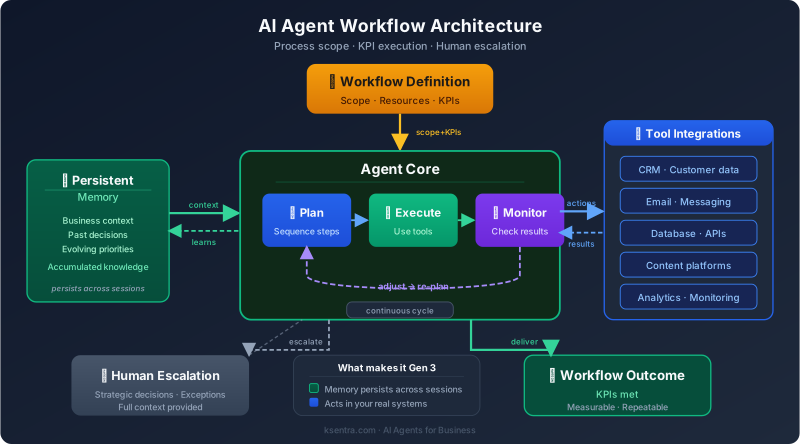
Every AI worker has a domain expert in the loop, by design — not as a fallback. Gen 3 systems are scoped narrow so they execute reliably, which means the interesting exceptions fall out of scope for the engine and in scope for a human. The expert reviews what the agent flags — output below the quality bar, an ambiguous instruction, an edge case — resolves it, and feeds the resolution back into the worker's configuration.
Who the expert is: Ksentra-side by default, included in the retainer — an SEO specialist, a contextologist, a content marketer, an SMM manager, or a marketing director, depending on the worker. If you'd rather your own person hold that role, we train them and the retainer drops.
No worker we build runs fully autonomously, and we won't describe one that way.
Onboarding an AI Worker
An AI worker is onboarded like a hire. Six things get configured before it does real work on your account, and together they are the contract for what it does and does not touch.
A process map
We map the target process end to end: the inputs, the steps, the decision points, the quality criteria. We mark what automates by rule, what needs a human every time, and what runs on a conditional threshold.
Persistent memory
We build the context layer: accumulated knowledge about your business, the decisions already made, the priorities. The worker does not start from zero on day one. It starts knowing what the process needs, and it keeps that context as it runs.
Integration into your infrastructure
We connect the worker to your systems: CRM, email, databases, content platforms, analytics APIs, messengers. It acts inside your environment, not in a separate console. We name the hosting (your perimeter, a regional cloud, or on-premise), the language model and its provider, and where customer data is stored. For personal data we work to the applicable regulation and sign the data-processing agreement.
KPIs and escalation rules
We set two or three measurable targets and the definition of "done", write them into the SLA, and agree what happens when a target is missed. We define the escalation signals up front: low model confidence, a sensitive topic, a direct request for a human, an external system failing, the same question repeating. Every handoff carries full context, so the person picking it up never starts from "tell me again from the beginning". Where it fits, part of the fee can ride on hitting the numbers.
Monitoring and feedback
We set up monitoring against your quality criteria: spot-check whenever you want, measure how much the worker actually handles, and raise its autonomy as trust grows. A named domain expert owns the changes. When your pricing, catalogue or rules change, the contract says who updates the worker's behavior and in how many working days, with a test environment before go-live and a change log you can roll back. Your operators get a channel to flag what it handles badly.
Supervised launch, then autonomous operation
We launch in pilot mode, check quality on real work, and move to autonomous operation with the escalation rules agreed. You set the thresholds; we build them into the process. Nothing runs unattended until it has cleared your quality bar on your own cases.
How We Work
-
1
Process audit
1–2 weeksWe produce the process map: inputs, steps, decisions, outputs, quality criteria, and the split between what runs by rule, what needs expert knowledge, and what needs threshold control. Everything downstream is built against it.
-
2
Architecture design
1 weekWe design the memory model, the tool integrations, and the goal structure. You sign off before development starts, so there are no surprises in the build.
-
3
Development and integration
2–4 weeksWe build the worker, connect it to your systems, and stand up the monitoring layer. The timeline depends on the number of integrations and the complexity of the process.
-
4
Supervised testing
1–2 weeksWe run it on real tasks alongside your team. We measure quality against your criteria, tune the behavior, and log the exceptions.
-
5
Autonomous operation + support
We hand over with documentation, escalation rules, and a feedback channel. Optionally, Ksentra runs the worker for you: you get the results, we keep the system working. Either way, your exit terms hold — process docs, accumulated data, tuned configuration and decision logic, in standard formats, on a turnaround written into the contract.
Interview It Like a Hire
You wouldn't hire someone to run a critical process off a slide deck. You'd interview them, agree the KPIs, and discuss what happens if it doesn't work out. An AI worker is a hire, and it holds up to the same questions:
- What does it remember between sessions, and who can see and correct that memory?
- Which of your systems does it act in, and what exactly can it do in each?
- Which KPIs will the provider commit to in writing?
- What happens when it hits a situation outside its rules?
- Who updates its behavior when your process changes, and how fast?
- Whose infrastructure does it run on, and who sees customer data?
- What's the cost of leaving after a year?
We answer all seven in the first consultation, and the answers that belong in the contract go into the contract.
The Ksentra AI SEO Worker
The clearest proof we can offer is the worker that runs this website's content.
It's given a content calendar and monthly KPIs as input, and it runs the full pipeline against them: keyword research, competitor analysis, content strategy, drafting, multi-critic quality review, revision, and distribution. An SEO specialist is the expert in the loop. They review what the worker escalates, make the strategic calls, and pull the Search Console and Webmaster reports the worker doesn't touch. Publishing to the CMS and decisions on strategic pivots stay with the human.
Externally, the same worker runs for Shoe IT, an e-commerce SEO operation, producing the content pipeline against KPIs the founder reviews each month — alongside their prior classical-marketing track, not replacing it.
This is what the arrangement looks like when it's real: the engine does the volume, a named expert owns the result, and the division of labor is written down.
The Economics: About Half a Full-Time Hire
For common business functions we've already built and proven the worker, so setup is quick and the engagement is a fixed monthly retainer. A worker built for a non-standard process follows the full timeline above and is priced by scope.
| Worker | Price | Status |
|---|---|---|
| AI SEO worker — 10 articles/mo, 2,000–3,000 words each | from $4,500/mo + $6,000 setup | Live |
| AI Advertising agent — Yandex Direct / Google Ads | from $4,250/mo + $6,000 setup | In active development |
| AI SMM agent — multi-channel distribution | from $4,000/mo + $4,500 setup | In active development |
| AI Marketing Director — OKR-driven orchestration | bundle-only — inside the AI Marketing Team | Operational internally, productizing for external delivery |
| AI Marketing Team bundle — director + specialist workers | from $19,500/mo + $25,000 setup | Operational internally, productizing for external delivery |
The equivalent in-house hires cost $37,000–$41,000/mo in real terms — a marketing director plus two specialists, once you count salary, payroll tax, benefits, and workplace overhead. A productized retainer runs about 2× cheaper, covers the work around the clock, and carries no payroll overhead.
If your process is specific enough to need a purpose-built worker, it's priced by scope and integration count. See the build tiers on the AI Agents page.
Every engagement starts with a free consultation and a fixed estimate — no commitment.
Frequently Asked Questions
What's the difference between an AI worker and an AI agent?
An AI agent is the engine — memory, tool access, workflow execution against given KPIs. An AI worker is that engine plus a named domain expert who owns the judgment, KPIs written into an SLA, and a manager on your account. Same generation (Gen 3); the difference is what you're buying — a system versus an outcome someone is accountable for.
Who is the "manager," exactly?
A specific domain expert on the Ksentra side, included in the retainer — an SEO specialist, contextologist, content marketer, SMM manager, or marketing director, depending on the worker. You know their name and what they do on your account each week. If you prefer your own person in that role, we train them and the retainer is lower.
What KPIs can you actually commit to in the contract?
Two or three measurable targets appropriate to the workflow — for a content worker, published pieces meeting the quality bar and organic traffic movement; for support triage, share of cases resolved without a human and escalation quality. We agree the numbers and the consequence of missing them during scoping, before the contract is signed.
What happens when my business changes?
The contract names who updates the worker's behavior and the turnaround in working days. You review changes in a test environment before they go live, the change log supports rollback, and your operators have a channel to report what the worker handles poorly.
Can I take it with me if I switch providers or bring it in-house?
Yes. Your exit terms are in the contract: process documentation, accumulated data, tuned configuration, and decision logic, exported in standard formats within a defined turnaround.
What does an AI worker cost?
A productized retainer runs from $4,000/mo plus setup, which is roughly half the loaded cost of the equivalent full-time hire. A purpose-built worker for a specific process is priced by scope. Every engagement begins with a free consultation and a fixed estimate.
Is an AI worker fully autonomous?
No — and that's deliberate. Every AI worker has a domain expert in the loop who handles what falls outside the worker's scope. Gen 3 systems are kept narrow so they execute reliably; the human keeps the exceptions.
Ready to hand a process off?
We will pick which processes to hand to AI workers and estimate the cost of rollout.