Digital AI Transformation
Your team already knows what questions they'll get asked today. They just spend hours answering them anyway. We configure AI assistants that give accurate answers from your own knowledge — instantly, consistently, without pulling a person into every conversation.
Gen 2 of 5 — Dialog-Depth Expertise. What does this mean?
What Is an AI Assistant for Business, Exactly?
You've used ChatGPT. An AI assistant for business is what happens when we configure that intelligence specifically for your company — your products, your pricing rules, your internal procedures, your brand voice.
Unlike a generic AI, a custom AI assistant only knows what you teach it. It draws on your knowledge base, your documents, and your workflows. It answers from your actual data — not from guesswork or outdated training sets.
For example: a sales rep asks "What's the price for Plan B with 50 users?" — the assistant returns the exact tiered rate from your pricing sheet in seconds, not a generic estimate.
This is Generation 2 of AI integration — dialog-depth AI. Unlike a generic chatbot, an AI assistant is configured as a domain specialist: it converses in the language of your business, holds session context, and refines its answers through dialogue. It doesn't execute workflows autonomously — it consults, advises, and helps your team reach the right answer faster. For many businesses, this is exactly the right level. (The technical mechanism behind the accuracy is retrieval-augmented generation — how RAG works.)
→ How the 5 Generations of AI work in practice
How an AI Assistant Works in Your Business
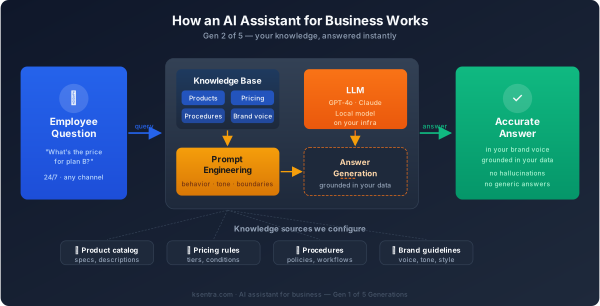
We set up the AI language model (GPT-4o, Claude, or a local model) with your company's knowledge as its context. Answers are grounded in your actual documentation — not general internet training data. Your sales team gets product specs right. Your support team gets policy answers right. Your marketing team gets brand-voice drafts right.
The assistant doesn't act in your systems. It answers, generates, and classifies. That predictability is a feature — the assistant does exactly what you configured, nothing more.
Our AI Assistant Setup Process
Discovery
— 1 weekWe audit your existing knowledge, identify the highest-value use cases, and define what the assistant handles vs. what stays with people.
Knowledge Base Build
— 1–2 weeksWe structure, clean, and format your documentation for LLM consumption. Missing knowledge gets documented. Outdated content gets flagged.
Configuration & Testing
— 1–2 weeksWe configure the LLM, write system prompts, and test against real use cases until output quality meets your standards.
Handoff & Support
Team training, documentation, and optional ongoing prompt maintenance as your business evolves. Typically 1–3 months to stable state.
Built on 15 Years of Delivery
Ksentra has deployed AI systems across financial services, e-commerce, and operations — from Gen 2 specialist AI assistants to full Gen 3 AI agent workflows. Every engagement starts at the right generation for the business problem.
Frequently Asked Questions
What's the difference between an AI assistant and an AI chatbot?
Both are Gen 2 — dialog-depth AI. The distinction is the use case and audience. An AI chatbot (like our Royal Finance implementation) is customer-facing: it handles inbound queries, qualifies leads, and guides people through products. An AI assistant is typically internal or professional: it serves your team or your clients as a domain expert — legal adviser, financial analyst, HR specialist. Same depth of integration, different application. We'll recommend the right fit after a 30-minute scope call.
What do we need to provide to get started?
Your existing documentation: product catalog, pricing sheets, internal procedures, brand guidelines, and FAQ content. If it's scattered across drives and email threads, we help you structure it as part of the setup. A point of contact who knows your business well is the only other requirement.
How long does setup take?
3–5 weeks for a standard configuration. Fast if your documentation is organized; slower if we're building the knowledge base from scratch. We give you a fixed timeline after the discovery audit.
What does it cost?
Setup: $500–$5,000 depending on knowledge base complexity and integrations. Optional ongoing support: $200–$800/month for prompt maintenance and knowledge updates. Every project starts with a free consultation and a fixed estimate — no commitment.
Have you done this for companies in my industry?
We've set up AI assistants for financial services, professional services, and e-commerce. The pattern is the same across industries: structured knowledge + prompt engineering + language model = consistent, accurate output. Industry-specific knowledge is what you provide; we bring the configuration expertise. You own the prompts, the knowledge base, and the infrastructure — ask us about the right stack for your business.
What's the difference between this and just using ChatGPT?
Generic ChatGPT knows nothing about your business. It will hallucinate your prices, misrepresent your products, and default to general advice when you need company-specific answers. A custom AI assistant is configured with your knowledge as its context — it only answers from what you've given it. The difference is the gap between "a smart answer" and "the right answer for your business."
Pricing
| Tier | Investment | Timeline |
|---|---|---|
| Focused assistant (1–2 use cases) | $500–$1,500 | 3 weeks |
| Full knowledge base + multi-use-case | $1,500–$3,500 | 4–5 weeks |
| Enterprise knowledge base + integrations | $3,500–$5,000+ | 5–7 weeks |
Optional monthly support: $200–$800/month. Includes prompt maintenance, knowledge updates, and usage review.
Every AI assistant project starts with a free consultation and a fixed estimate — no commitment.