Digital AI Transformation
AI Marketing Team
AI marketing team — director + 4 specialist agents (SEO, Writer bundled with SEO, ads, social) coordinated against your OKRs.
One AI agent executes one workflow. An AI team runs multiple workflows simultaneously — and keeps them aligned. When your SEO agent, content agent, and analytics agent share the same state, exceptions get routed automatically, KPI drift gets caught early, and no human coordinator spends their day chasing handoffs. We design and build AI teams that orchestrate your AI agents as a coordinated operating layer.
What Is an AI Team, Exactly?
You may already be using AI agents — or thinking about them. A single AI agent executes a workflow: it has memory, uses your tools, and works toward a defined outcome. An AI team is the layer above: an orchestration system that coordinates multiple agents sharing state.
The difference is meaningful. Without orchestration, each agent works in its own context. The SEO agent doesn't know what the analytics agent found. The content agent doesn't know the SEO strategy shifted. Each is capable on its own — but they're not a team.
An AI team changes that. A shared state layer connects agents so they can route work between each other, pass context on handoffs, and react to signals from across your operation — without a human coordinator in the middle. The orchestrator monitors KPIs across all processes and manages by exception: when something drifts or fails, it escalates. When everything is running, it stays out of the way.
This is Generation 4 of AI integration — the level where multiple AI agents become a coordinated capability, not a collection of individual tools.
→ See the full 5 Generations of AI Business Systems framework
How an AI Team Works
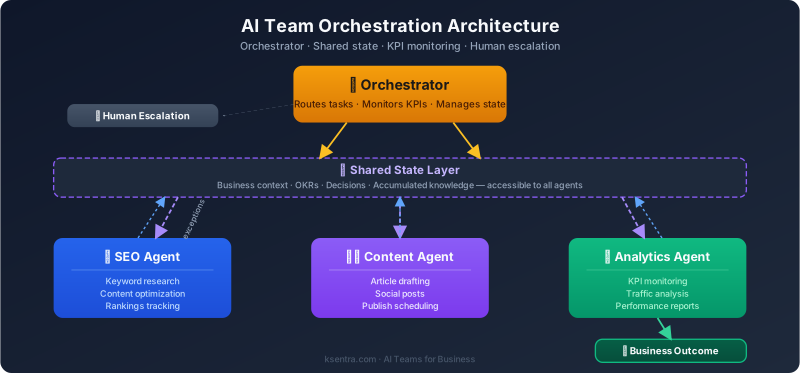
An AI team for business operates through three components: the agents, the orchestrator, and the shared state layer. Each agent handles its own domain — SEO research, content production, performance analytics. The orchestrator monitors KPIs across all of them and manages by exception: when the analytics agent detects a conversion drop, the orchestrator can signal the content agent to reprioritize topics and the SEO agent to adjust targeting — without a human coordinating the handoffs. The shared state layer is what makes this possible: all agents read from and write to a common context, so each one knows what the others have done.
This is what a multi-agent AI system looks like in practice — not parallel chatbots, but a coordinated AI operating layer.
How We Work
Architecture Audit
— 1–2 weeksWe assess your existing Gen 3 AI agents (or design them if needed), map inter-agent workflows, and define the orchestration architecture — what gets coordinated, how, and under what conditions.
Orchestration Build
— 4–8 weeksWe develop the orchestration layer: shared state infrastructure, task routing logic, handoff protocols, and KPI monitoring dashboards.
Integration and Testing
— 2–4 weeksWe connect agents through the orchestrator, run coordinated workflow tests, and calibrate exception thresholds. We verify that the team handles edge cases — not just the happy path.
Live Operations and Optimization
— OngoingWe monitor KPIs, tune routing logic, and expand the AI team as new workflows are ready to join the orchestration layer. Managed operations available.
Built on Working Gen 3 Foundations
Ksentra's own marketing operation runs on a Gen 3 AI agent — a fully operational SEO and content pipeline executing at process depth: persistent memory, tool integrations, and KPI-measured outputs across months of operational use. The Gen 4 orchestration layer is the natural next step as our second agent (Advertising Agent) comes online.
We don't sell Gen 4 as a concept. We build it from agents we've already proven. When we design an AI team for your business, we start from what works — and build up.
Frequently Asked Questions
Does my business need a Gen 3 AI agent before building an AI team?
Yes — an AI team orchestrates agents that already exist. If you don't have working Gen 3 agents yet, the right starting point is AI agent development. We'll help you build the agents first, then add orchestration once you have at least two running in the same domain. Trying to orchestrate agents that haven't been built yet is architecture for architecture's sake — and it doesn't deliver business value.
What do you need from us to start designing an AI team?
A clear picture of your current or planned AI agents — what they do, what systems they touch, and where the handoffs happen today. Access to your existing agent infrastructure (or the scope to build new ones). And a decision-maker who can define KPI thresholds: what counts as normal operation, and what counts as an exception worth escalating.
How long does it take to deploy a functioning AI team?
For businesses with two working Gen 3 agents, the orchestration layer typically takes 6–12 weeks end-to-end — architecture, build, integration, and testing. Timelines extend if agents need to be built first or if the workflow domain is complex. We scope each engagement before committing to a timeline.
What does an AI team cost?
AI team engagements start from $10,000 for architecture and orchestration build, with ongoing operations from $2,000–$5,000/month depending on the number of agents, monitoring complexity, and the scope of managed operations. We use a base fee plus a success component tied to KPI outcomes — our incentives are aligned with your results. We'll scope the project on the first call.
Have you deployed multi-agent systems for external clients?
Gen 4 is the most technically advanced offering in our catalog, and we're honest about where we are: Ksentra's own marketing operation is the first full deployment, with external client engagements opening in 2026. The architecture is proven — our AI SEO agent has run reliably through months of operational use. The orchestration layer is the next build. If you're interested in an early engagement, reach out and we'll discuss readiness on both sides.
What happens if one agent fails — does the whole team stop?
No. The orchestration layer includes exception handling specifically for agent failures: fallback routing, human escalation triggers, and graceful degradation. If the analytics agent goes offline, the orchestrator escalates to a human rather than letting the SEO and content agents operate without signal. Failure isolation is a core design requirement, not an afterthought.