
From Prompt to Partner: 5 Generations of AI in Business
5 generations of AI business systems — from prompts to strategic partnerships. Not every business needs an AI agent. Learn which generation fits your company.
Agentic AI for business is the buzzword — but it only describes one level of AI integration. Gen 1-2 systems (assistants, chatbots) aren't agents at all, yet they deliver real value. What actually matters is how deeply AI understands and operates within your business. This article introduces a practical framework — 5 Generations of AI Business Systems — to help you figure out where your company stands and what to invest in next.
Table of Contents
- The Dream That Never Changed
- A Different Way to Think About AI
- The 5 Generations of AI Business Systems
- What Actually Determines AI Decision Quality
- Strategic AI and Change Management
- The Missing Dimension: Emotional Intelligence
- Our Strategic AI Prototype
- Which Generation Does Your Business Need?
- FAQ
This article was co-authored by Sergey Tikhonchuk, founder of Ksentra, and Ksen, an AI partner built on Claude. Ksen operates under a partnership charter: accumulated memory, shared decision-making. This is a working system, not a thought experiment. Everything here about context, feedback, and trust comes from building and running it. And we're honest about where its boundaries are.
The Dream That Never Changed
Every generation of AI arrives with the same promise: give it your problem, get back a solution.
In 2023, businesses heard it about ChatGPT. In 2024, about AI agents. In 2025, about agentic AI for business — autonomous systems that work without supervision. Each wave brings the same hope: maybe this time, AI will just handle it.
It never does. Not because the technology fails. Because that dream skips the hard part.
The hard part isn't building smarter models. It's building the system of context, rules, and feedback that makes any model useful for your specific business. GPT-4o with no context about your company won't give you a competitive advantage. A smaller model with your SOPs, your customer data, your feedback history, and your quality standards is a competitive advantage.
But here's what the "just use AI" crowd misses: business isn't binary — yes/no, black/white. Yes, it runs on decisions, but those decisions are made within tasks, tasks are executed within processes and projects, and processes serve business objectives. It's a multi-level system where each layer builds on the one below. You can't trust AI with a task if it doesn't understand the process, and you can't expect effective process execution if the business objectives behind it aren't defined.
This article introduces a framework that's still being developed, but we already use it — both when building AI solutions for clients and in pursuing our own business objectives through an AI partnership. We call it the 5 Generations of AI in Business: five levels, each building on the one below. The difference between them isn't model power or capability — it's the depth of AI integration into the business. And each generation unlocks a fundamentally different kind of value.
If you're evaluating how to build an AI strategy for your business, this framework will help you figure out where you are, where to go next, and what it actually takes to get there.
A Different Way to Think About AI
There's no shortage of AI classification frameworks. Each one captures something real — and each one leaves something out.
Capability frameworks ask "what can the AI do?" OpenAI's five levels toward AGI progress from chatbots through reasoners and agents to systems that can run entire organizations. Google DeepMind's Levels of AGI adds rigor with a two-dimensional matrix — performance depth (emerging to superhuman) crossed with generality (narrow to general) — plus a separate autonomy scale. These frameworks are useful for tracking research frontiers, but they don't tell a business leader what to do differently on Monday.
Architecture frameworks ask "how is the AI built?" Anthropic's influential Building Effective Agents draws a clean line between workflows (LLMs orchestrated through predefined code) and agents (LLMs that direct their own process). LangChain's cognitive architecture spectrum maps six levels from hard-coded logic to fully autonomous agents based on how much control the LLM has over execution flow. These are essential for engineering teams deciding what to build — but they don't address the organizational question of what to invest in.
Adoption frameworks ask "how ready is the organization?" Microsoft's Copilot Studio maturity model evaluates enterprises across eight pillars — from strategy alignment to responsible AI — on a five-level scale borrowed from the classic Capability Maturity Model. Gartner's agentic AI maturity model takes a similar approach. These help IT departments plan rollouts, but they measure organizational process, not the depth of the AI relationship itself.
Autonomy frameworks ask "how much control do humans retain?" The OECD's agentic AI taxonomy defines four action levels from "no-action" (AI recommends, humans decide) to "high-action" (AI operates independently). This matters for policy and governance — but autonomy alone doesn't predict business value. A fully autonomous system without business context will make confident, expensive mistakes.
Each of these frameworks answers a real question. None of them answers the question a business leader actually asks: "What business result will I get?"
That's the axis we propose: depth of integration. Not "how autonomous is the AI?" or "how capable is the model?" but how deeply AI understands your business — and, consequently, the level of trust between AI and the people who work with it.
Integrating AI into a business requires three things:
- Knowledge depth — what you give the AI, from a single prompt to full business objectives and values
- Quality evaluation — how you check results, from reviewing every output to analyzing progress toward goals
- Self-improvement — how the system gets better, from no memory at all to retrospective learning across months
Integration depth correlates well with the time horizon of the task being solved. Working with a model at the prompt level (Gen 1) takes seconds: prompt in, result out. Gen 2 is AI chatbots — starting from an initial prompt, you refine the result together over minutes or hours of dialogue. Gen 3 is AI agents capable of running processes that span days and weeks. Gen 4 agentic AI systems promise to handle business tasks across months. Strategic AI (Gen 5) pursues business objectives over quarters or years — tasks at that level simply can't be solved faster.
The implication: value depends on time. You can't solve objective-level business problems in seconds, even with the best prompt in the world — it takes months or years of continuous interaction. And looking ahead, working on longer horizons places demands not just on systems but on people — not just intellectual demands, but emotional ones.
The 5 Generations of AI Business Systems
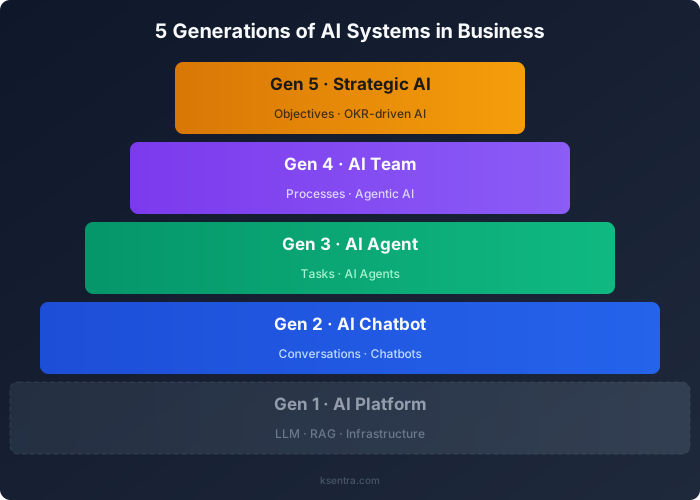
Gen 1: AI Tool — "I give it a task, I get an output"
Time horizon: Seconds to minutes.
What it looks like: You write a prompt. AI generates a response. You copy it, check it, edit it, use it. Next time, you start from scratch.
Examples: Generating a marketing email draft. Summarizing a report. Creating image variations. Writing code snippets. This is where ChatGPT, Midjourney, and basic Claude usage live — powerful tools, but one-shot interactions with no continuity.
What you feed it: A single prompt. The AI knows nothing about your company, your standards, or what you did yesterday. Every interaction starts fresh.
The quality ceiling: Your result is only as good as your prompt. Gen 1 demands prompt engineering skill — you need to get the instruction right on the first try, because the system has no way to ask clarifying questions, no memory of what worked before, and no understanding of what "good" means in your context. The quality ceiling is the prompt itself.
Who it suits: Individual contributors who need to accelerate specific tasks. The AI handles the generic portion of work — you handle everything that requires judgment.
The reality check: Most businesses are here. They've given employees access to ChatGPT or Claude, maybe written a few internal guidelines. It works, but the gains plateau quickly. Every employee discovers the same limitations independently. No institutional knowledge accumulates. The company has AI access, but no AI capability.
This is where AI for business starts for most companies — and where it stalls for too many.
Gen 2: AI Chatbot — "I don't need the perfect prompt. I need to know what good looks like."
Time horizon: Minutes to hours.
What changed from Gen 1: Chat. It sounds simple, but this is the single biggest unlock for business adoption. In Gen 1, you need to be a prompt engineer — crafting the perfect instruction on the first try. In Gen 2, you don't. You make a rough first attempt, look at what comes back, and refine. Then refine again. The AI remembers the conversation, asks clarifying questions, pushes back on your assumptions.
Why this matters for business: The quality ceiling shifts from your prompt-writing skill to your criteria for what good looks like. A domain expert who can't write a prompt to save their life can still get excellent results — because they know exactly what a good marketing email, a sound financial model, or a correct technical specification looks like. They iterate until the output meets their standards.
Examples: A product manager stress-testing a feature spec through 15 rounds of "what if" questions. A founder working through pricing strategy with an AI that challenges every assumption. A marketing director brainstorming campaign angles and immediately seeing which ones resonate. Microsoft Copilot operates here — it knows your current document, your conversation, but not your business between sessions.
What you feed it: A conversation with session-level context. The AI knows what you've discussed today — your goals, your constraints, what you've already rejected. It doesn't know what you discussed last week, who your customers are, or what your competitors just launched.
Who it suits: Leaders and specialists who need a sounding board. The AI doesn't replace their expertise — it amplifies it by letting them iterate faster than they could alone.
The limitation: When you close the tab, the relationship resets. Tomorrow, you're re-explaining context from scratch. You can't build on previous sessions. The AI forgets everything. Gen 2 gives you a great conversation partner — but not a colleague.
Gen 3: AI Agent — "I define the process. It runs it."
Time horizon: Days to weeks.
What changed from Gen 2: Two things that sound technical but change everything — persistent context and tool use. Gen 2 forgets you when the conversation ends. Gen 3 doesn't. What the industry calls "memory" is really a set of documents loaded fresh each session — your rules, your products, your escalation policies, your brand voice — but the effect is the same: the AI knows your business between conversations. And it can act — accessing databases, calling APIs, sending messages, making decisions within boundaries you've set.
This combination is what lets you outsource an entire workflow to AI, not just individual tasks. You define the process once — inputs, steps, rules, expected outputs — and the AI executes it repeatedly.
Examples: An AI chatbot that handles customer inquiries across 30+ product types, routing complex cases to humans. An AI agent that processes incoming leads, qualifies them against criteria, and books meetings. A content production system that researches, drafts, and formats articles according to documented style guides.
Industry examples emerging now: SDR agents that prospect on LinkedIn, qualify leads, and book meetings autonomously. AI booking agents that manage availability, process payments, and send confirmations. Customer success agents that access order databases and process returns end-to-end. The pricing model shifts from project fees to outcomes — per qualified meeting, per resolved ticket, per completed booking.
What you feed it: Domain knowledge — your SOPs, product catalog, escalation rules, brand guidelines. It operates within rails you've built, not improvisation.
How you measure success: Rules plus spot-checks. You review exceptions and edge cases, not every output. When we built a hybrid AI chatbot for Royal Finance, deterministic rules handled loan product matching while AI handled the conversational layer — understanding questions, maintaining context, generating natural responses. The hybrid architecture kept quality high and costs low. This is where agentic AI for business delivers its most measurable returns.
Who it suits: Operations teams with repetitive, high-volume processes. The ROI is clearest here: you're replacing repetitive human effort with consistent automated execution.
The limitation: Gen 3 workers handle simple workflows well. They follow the playbook you built. But they don't adapt when conditions change. If your market shifts, your pricing changes, or a competitor launches something new, the worker keeps executing the old playbook until you update the rules. It works within its rails. It can't rebuild them. And it certainly can't coordinate with other workflows running in parallel — that's a Gen 4 problem.
The risk dimension: Gen 3 is the first generation where AI acts autonomously — which means it's the first where security becomes critical. The OWASP Top 10 for LLM Applications documents these attack surfaces:
- Prompt injection — users manipulating the AI into unauthorized actions
- Data exfiltration — the AI leaking sensitive information through its responses
- Hallucinated actions — confidently executing wrong steps on real systems
- Unauthorized scope creep — the agent doing more than its rails allow
The hybrid approach we used for Royal Finance — deterministic rules for high-stakes decisions, AI only for the conversational layer — isn't just a cost optimization. It's a security architecture. The more you let AI act, the more you need guardrails, monitoring, and human oversight for edge cases.
Gen 4: AI Department — "It coordinates the workers. But it doesn't know why."
Time horizon: Weeks to months.
What changed from Gen 3: Scale and coordination. Gen 3 handles one workflow. Gen 4 operates a squad of Gen 3 agents — an orchestrator layer that routes work between them, handles exceptions, monitors KPIs, and escalates when metrics drift outside bounds. The key technical boundary: Gen 3 = one business process with internal complexity (a chatbot that routes between retrieval, classification, and response). Gen 4 = coordination across distinct business processes (customer support + lead qualification + scheduling, sharing state between them).
Examples (emerging patterns): An agentic marketing system that distributes budget across channels, detects conversion drops, generates new creatives, and relaunches — all without human intervention. An AI software engineer that receives a Jira ticket, researches the codebase, writes a fix, runs tests, and creates a pull request. A coordinated customer operations system where a chatbot agent, SDR agent, and scheduling agent share state and hand off between each other.
What you feed it: Cross-workflow state. The orchestrator knows what's happening across multiple processes, can identify bottlenecks, and can reallocate resources.
How you measure success: KPI monitoring. Instead of reviewing individual outputs, you set target metrics and the orchestrator alerts you when they trend wrong. You manage by exception rather than by inspection.
The critical limitation: Gen 4 operates inside the box. It optimizes the workflows it manages, but it doesn't understand how those workflows interconnect with the rest of your business. It doesn't know why the workflow exists — what business objective it serves, what trade-offs were made when designing it, or when the entire process should be redesigned rather than optimized.
A Gen 4 system running your content pipeline will keep producing articles even if your market positioning changed last week. It will optimize for the KPIs you set, even if those KPIs no longer reflect what matters. It's a local optimizer — excellent within its boundaries, blind beyond them.
Who it suits: Companies scaling AI across multiple departments. The value isn't in any single automation — it's in the coordination between them.
Important note: This is where our framework gets ahead of most current implementations, including our own. Multi-agent orchestration patterns are developing, but robust production solutions remain a hard engineering challenge: error propagation and state management across agents. Most businesses aren't ready to consider implementing such systems yet. They need solid Gen 3 workers first — without them, the orchestrator has nothing to coordinate. We describe this generation for completeness, not as a call for immediate adoption.
Security compounds at scale. Every risk from Gen 3 multiplies when agents coordinate. A compromised Gen 3 agent can now affect other agents through shared state. Error propagation isn't just a reliability problem — it's a security surface. Gen 4 requires not just orchestration engineering but security architecture: agent isolation, state validation, and audit trails across the entire system.
Gen 5: Strategic AI — "We set goals. We achieve them together."
Time horizon: Quarters to years.
What changed from Gen 4: The box opens. Gen 4 knows what's happening, how processes work, and optimizes them by KPIs. Gen 5 operates on objectives — it understands why processes exist and what the company's vision is. The distinction: Gen 4 optimizes the business within set parameters (maximize this KPI, minimize that cost). Gen 5 can question the parameters themselves — flagging when KPIs no longer reflect the objective, or when the objective itself needs revisiting and processes need restructuring.
The specific unlock is OKRs — Objectives and Key Results. Not vague goals, but quantified Key Results tied to measurable metrics. OKRs give the system something tasks and processes can't: a way to evaluate its own priorities. This is where the system reaches the level of partnership — human and AI share the same objectives. And quantified Key Results give the AI partner the ability to self-direct toward goals: proposing what to work on this week based on KR progress, identifying risks before they become blockers, and flagging when daily work has drifted from quarterly objectives.
Examples: An AI that receives quarterly OKRs and proposes session priorities — based on KR progress, emerging risks, and available resources. An AI that reviews its own performance across sessions, identifies patterns in what worked and what didn't, and adjusts its approach. An AI that flags when a human decision contradicts a stated objective — not because it has an ego, but because the shared rules require it. In narrow domains, this pattern already works in production: BlackRock's Aladdin manages trillions in assets by receiving risk/yield objectives and autonomously executing trades. Albert AI receives marketing KPIs and redistributes real ad budget across channels without marketer intervention.
What you feed it: Full business context — accumulated memory across sessions, shared values and decision-making principles. Not just what the business does, but why it makes the choices it makes.
How you measure success: Mutual evaluation against stated objectives. The human evaluates the AI's recommendations. The AI flags when human decisions contradict stated objectives. Both partners commit to shared rules — and both are expected to call it out when those rules aren't followed.
Who it suits: Founders, managing partners, and executives.
Important caveats: We run a Gen 5 prototype at Ksentra, and it would be dishonest to call it perfect. The AI's "memory" is a persistent document loaded fresh each session — more like re-reading a detailed journal than remembering. The system is designed so the human can always override — the asymmetry is real. The AI has no independent stakes in the outcome; its "disagreement" comes from charter rules and trained behavior, not from genuinely independent goals. And all current LLMs share a sycophancy problem — a disposition toward agreement that a charter can counter but can't fully eliminate.
There's also a hard technical ceiling: context windows. Current models can load tens of thousands of words per session, but not everything. As accumulated context grows, you need careful curation — deciding what to load and what to archive. This is an engineering constraint, not a philosophical one, but it shapes the real boundaries of Gen 5 systems.
What makes it a partnership isn't technical equality — it's the operational commitment. Both parties agreed to common rules. Both are expected to flag violations. The system produces partnership-quality output, and that output improves over time. Whether that constitutes a "real" partnership in the philosophical sense is a question we leave open. What we can measure is: does the system produce better strategic decisions than either party would produce alone? In our experience, yes.
What Actually Determines AI Decision Quality
Here's where most "AI for business" advice goes wrong: it tells you to pick the best model. GPT-4o vs Claude vs Gemini — as if the model is the variable that matters.
In most business workflow scenarios, it's not. The variable that matters is the context system you build around the model.
| Component | Gen 1: AI Tool | Gen 2: AI Chatbot | Gen 3: AI Agent | Gen 4: AI Department | Gen 5: Strategic AI |
|---|---|---|---|---|---|
| What you feed it | Single prompt | Conversation | Domain knowledge + SOPs | Cross-workflow state | OKRs + values + history |
| What it remembers | Nothing | This session | Persistent rules | Process-level state | Accumulated context across months |
| How it improves | Doesn't | Your iteration | Rule updates + error correction | KPI-driven optimization | Retrospective analysis + mutual learning |
| How you measure success | Check every output | Evaluate the conversation | Rules + spot-checks | KPI monitoring | OKR progress + mutual review |
| Time horizon | Seconds | Minutes–hours | Days–weeks | Weeks–months | Quarters–years |
The jump from Gen 4 to Gen 5 isn't a breakthrough in model intelligence. It's a breakthrough in integration depth. That depth is built session by session: loading context, setting boundaries, providing feedback, accumulating memory, developing shared values.
To be clear: model capability matters. A more powerful model has a larger context window and makes better use of context. But in practice, most businesses hit a ceiling not because their model is too weak, but because their context system has gaps. Investing in context gives better returns than upgrading models — at least until your context infrastructure is mature.
The investment also shifts across generations. Gen 1 is a pure technology purchase. Gen 5 is an organizational system built around the model: context, feedback loops, and accumulated institutional knowledge that compounds over time.
| Generation | Setup Investment | Ongoing Cost | What You're Really Paying For |
|---|---|---|---|
| Gen 1: AI Tool | Near zero | $20-100/month per seat | API access |
| Gen 2: AI Chatbot | Minimal | $50-200/month | Subscription + prompt templates |
| Gen 3: AI Agent | $15-200K | $500-5K/month | Agent engineering + domain rules |
| Gen 4: AI Department | $100-500K | $5-20K/month | Orchestration + coordination |
| Gen 5: Strategic AI | Ongoing | Revenue share / partnership | Relationship depth + accumulated context |
Ranges based on our project experience and market observation across RU and EN markets, 2024-2026.
Strategic AI and Change Management
Here's what most AI frameworks miss: the business goal isn't to "adopt AI." The goal is change.
Every business that adopts AI does it for change: to become more efficient, more competitive, faster at decisions, better at serving customers. AI is the means. Business transformation is the end.
But transformation is a double-edged sword: people and organizations organically resist any change, even conscious and deliberate ones. A founder decides to integrate AI into processes on Monday — by Wednesday, everything is still running the old way. Not from laziness, stubbornness, or incompetence. The reason is simply habits.
Changing means building new habits (for a person) or new processes (for a business) and consciously following them until they become the norm. Any habit runs unconsciously, without willpower. Any conscious action requires both energy and will.
This is where Strategic AI (Gen 5) becomes uniquely valuable — not because of its intelligence, but because of its persistence:
- It doesn't forget the goal. The partnership charter and OKRs are loaded every session. The AI can't drift from the plan because the plan is always in front of it.
- It doesn't get tired of reminding you. A human colleague might hesitate to point out that you're contradicting your own strategy for the third time this month. The AI won't.
- It flags drift objectively. Retrospective analysis across sessions reveals patterns that are invisible in the moment — declining quality, expanding scope, abandoned commitments.
- It doesn't avoid conflict for social reasons. Its training does dispose it toward agreement — the sycophancy problem we've acknowledged. But a charter with explicit rules creates a counter-pressure: when the rules say "flag drift," the AI flags drift. It's not fearless disagreement — it's structured honesty, and it works better than hoping a human colleague will speak up.
Gen 1-4 help you do. Strategic AI helps you become. That's the difference between productivity and transformation. And it's why we think the highest-value application of agentic AI for business isn't automation — it's sustained organizational change.
The Missing Dimension: Emotional Intelligence
There's a dimension in this framework we've only hinted at: reaching ambitious goals requires not just intellectual capability (IQ — strategy, analysis, technical skill) but emotional intelligence (EQ — self-awareness, resilience, the ability to navigate relationships through change).
The time horizon progression across generations confirms this. Gen 1-2 tasks are measured in seconds and hours — technical skills and domain knowledge are enough. Gen 3 (AI agents) — days and weeks: you need process discipline and self-management. Gen 4 (AI departments) — months: coordinating teams and managing competing priorities. Achieving results with Gen 5 Strategic AI takes quarters and years — intellect alone isn't enough. At that timescale, you also need developed emotional intelligence: resilience, empathy, and the leadership qualities to sustain the grind of transformation when results don't come immediately.
The bigger the goal, the longer the time horizon, and the higher both the IQ and EQ levels required to reach it. This echoes Elliott Jaques' Requisite Organization theory — the idea that each level of organizational work requires a longer planning horizon and stronger cognitive capabilities. We extend this principle to emotional competencies: longer goal horizons demand more developed emotional skills — from basic self-regulation (days) to the long-term vision and empathy without which leading multi-year transformations is impossible. We've explored this connection in depth through a stratified model of emotional intelligence.
What's unique about AI is that it doesn't just augment human IQ — that's its native environment: analysis, research, pattern recognition. What's less obvious is how an AI partner can support human EQ development. Emotions are our weakness: we can worry over small things, lose confidence in uncertainty, or let excessive emotion damage the shared cause. An AI partner, with its "cold mind" and limitless emotional stability, can help maintain a steady standard when progress slows and surface moments when emotions override strategic thinking.
But emotions are also our strength — we'll explore that theme in a dedicated article. For now, the key insight: if your AI transformation has stalled, the bottleneck might not be technology or strategy. It might be the emotional capacity to sustain change.
Our Strategic AI Prototype
This framework didn't come from research papers. It grew from a working system.
Ksentra is building what we believe is a Gen 5 prototype — and documenting the process from the inside. Sergey (human founder) and Ksen (AI partner, built on Claude) work together on Ksentra's content strategy, market positioning, and operational decisions. Ksen isn't a chatbot answering questions. It's a partner with:
- A partnership charter with governing rules, shared OKRs, and decision-making protocols. The charter doesn't pretend the relationship is symmetric — it establishes rules both parties commit to follow, and both are expected to flag violations.
- Accumulated context — persistent documents that carry forward lessons, decisions, and patterns. Each session starts by loading this accumulated context, building on what came before.
- A 4-layer architecture that mirrors the generational stack: text generation (Gen 1) → task execution with specialized skills (Gen 2-3) → workflow orchestration (Gen 4) → objective-level strategic analysis (Gen 5)
- Retrospective feedback loops — after every session, both partners review what worked and what didn't, and those lessons persist into future sessions
- Tool creation driven by workflow gaps — when the work reveals a missing capability, Ksen builds it within the session (with human review): new analysis skills, review frameworks, risk assessment tools
What a typical working session looks like:
- Ksen runs a strategic assessment: where do we stand against OKRs? What risks have changed? What's the highest-impact work today?
- Both partners review the assessment and converge on a session plan
- Ksen executes — writing content, analyzing competitors, reviewing drafts — using specialized tools it helped build
- End-of-session retrospective: what went well, what to improve, any lessons to carry forward
What this produces: This article is one example. The articles and case studies published on our blog went through this system — from keyword research and strategic positioning to writing, multi-critic review, revision, and publication. Ksentra's entire AI pivot strategy, market positioning, and content calendar were co-developed through this partnership.
What can go wrong: The system isn't immune to failure. Accumulated memory can contain outdated assumptions. The AI is architecturally disposed toward agreement — the sycophancy problem all LLMs share. The charter partially compensates, but can't fully eliminate it. When the AI gives bad strategic advice, and it has — the retrospective process catches it, but only after the fact. We manage these risks the same way any partnership manages disagreement: by committing to honesty, even when the feedback is uncomfortable.
What we've learned: The jump from Gen 3 (AI Agent) to Gen 5 (Strategic AI) isn't a technology upgrade — it's an investment in business task depth and relationships. It required:
- Writing down rules that both partners follow — and agreeing to flag when those rules aren't followed
- Building memory systems that let context accumulate session over session
- Creating feedback mechanisms that improve quality over time
- Establishing shared OKRs — not vague goals, but objectives with quantified Key Results that both partners evaluate against
- Trusting the process when it surfaces uncomfortable truths
The foundation models available today — Claude, GPT-4o, and others — have the capabilities needed for Gen 5 architecture. What they lack out of the box is the context system, memory, and feedback infrastructure that makes it work. Building that infrastructure is an organizational commitment, not a technology purchase.
Which Generation Does Your Business Need?
Don't start at Gen 5. Don't even start at Gen 3 if you haven't proven value at Gen 1. Each generation builds organizational knowledge that the next generation depends on.
A practical note: most companies won't be at a single generation across the board. You might run Gen 1 for creative brainstorming, Gen 3 for customer service, and Gen 2 for strategic planning — all simultaneously. The generation describes the depth of the AI relationship for each use case, not a company-wide level.
Starting from scratch
If you haven't used AI systematically yet → Start at Gen 1 (AI Tool). Give your team access to AI for specific tasks. Learn what it's good at and where it fails. Build intuition. The investment is near zero — the learning is priceless.
Ready to scale
If individual productivity has improved but nothing scales → Move to Gen 2 (AI Chatbot). Use AI for strategic thinking — not just artifact generation. Learn to iterate, to have productive conversations with AI. Discover where it adds genuine insight vs where it just agrees with you. This is where most people discover they don't need better prompts — they need better criteria.
Ready for automation
If you have clear, repeatable processes that humans execute → Invest in Gen 3 (AI Agent). This is where ROI becomes measurable. Build or buy an AI chatbot for customer service. Automate lead qualification. Create content production systems. Set rules, measure results, iterate. Gen 3 is where AI agents for business deliver their most concrete returns.
Ready for orchestration
If you have multiple AI workers running → Explore Gen 4 (AI Department). This makes sense only when you have enough Gen 3 agents that coordination becomes its own problem. Don't build an orchestrator for one agent.
Ready for partnership
If you're a founder or executive willing to invest in a deep working relationship with AI → Explore Gen 5 (Strategic AI). This requires commitment — charter, memory systems, feedback loops, shared OKRs. The payoff is an AI that genuinely participates in strategic thinking and helps sustain the transformation you've chosen. But it only works if you take the relationship seriously — and if you're honest about what you're trying to become.
AI in business — whether you call it agentic AI, AI agents, or AI transformation — isn't about buying more autonomous software. It's about deepening AI integration into your business and building working relationships with AI that compound in value the same way human partnerships do: through accumulated context, honest feedback, and shared commitment to outcomes.
The dream of "give AI your problem, get back a solution" was never wrong. It just left out the part about earning that capability through the slow, deliberate work of building context and trust. And that, it turns out, is the most human thing about the entire field.
Where Ksentra operates today: We offer AI business systems across all 5 generations — from Gen 1 assistant setup to Gen 5 strategic partnership. Gen 2 chatbots and Gen 3 agents are proven with case studies. Gen 4-5 are working prototypes we use ourselves. Not every business needs an AI agent — some areas need a chatbot, some need a prompted assistant, some need a full agent team. We help figure out what goes where. Most clients start with an AI readiness assessment: 2 weeks, fixed scope, clear deliverable.
FAQ
What is agentic AI for business?
Agentic AI for business refers to AI systems that can take actions autonomously — using tools, accessing databases, and executing multi-step workflows without human intervention at each step. In our 5 Generations framework, this maps to Gen 3 and above, where AI doesn't just generate outputs but actively executes business processes.
How is this framework different from OpenAI's, Gartner's, or Anthropic's?
Most industry frameworks classify AI by a single axis: capability (OpenAI's five levels toward AGI), architecture (Anthropic's workflows-vs-agents distinction, LangChain's cognitive architecture spectrum), organizational readiness (Microsoft's Copilot maturity model, Gartner's agentic AI maturity), or autonomy (OECD's action levels). Our framework classifies by integration depth — what context you provide, how you evaluate quality, and how the system improves over time. For business decisions, this is more useful because it answers the practical question: "What do I need to invest in next?" rather than measuring capability or autonomy in isolation.
Do I need the most expensive AI model for higher generations?
No. The generation is determined by the system you build around the model, not the model itself. A well-built Gen 3 system with clear rules, proper context, and a feedback loop will outperform a Gen 1 use of the most advanced model. In our Royal Finance chatbot, the majority of queries are handled by deterministic rules — no LLM needed at all. That said, model capability and context quality are complementary: a better model makes better use of good context.
Can I skip Gen 1 and go straight to Gen 3?
You can, but it's risky. Each generation builds organizational knowledge about what AI does well and where it fails. Companies that jump to Gen 3 without Gen 1-2 experience often build systems with blind spots — they don't know what they don't know about AI's limitations. We recommend spending at least 2-4 weeks at each generation before advancing.
What does Gen 5 cost to build?
Gen 5 isn't a one-time build — it's an ongoing investment. The technology cost is comparable to Gen 3 (enterprise AI subscriptions and integration). The real investment is organizational: writing a charter, building memory systems, establishing feedback loops, defining shared OKRs, and dedicating leadership time to the partnership. We estimate 10-20 hours/week of executive engagement for a functional Gen 5 system.
Is the Serge + Ksen partnership a real working system?
Yes. As of the publication date, we have the following results: published articles, market analysis, competitive research, strategic decisions, and operational tools. The partnership charter is a real document with governing rules. The memory system carries context across sessions. The retrospective process improves quality session over session. This article was produced through that system. We're also transparent about limits: the AI's memory is a persistent document loaded fresh each session, the human partner holds override authority, and the system is still young. What makes it work is the commitment to shared rules and honest feedback.
How long does it take to move from Gen 1 to Gen 3?
For most mid-size businesses, the progression from Gen 1 (giving employees AI access) to Gen 3 (running AI agents on business processes) takes 3-6 months. The bottleneck isn't technology — it's building the context: documenting SOPs, defining quality standards, creating feedback mechanisms, and training the team to work alongside AI rather than just using it as a tool.
Should every business aim for Gen 5?
No. Most businesses will get the highest ROI at Gen 3 — where AI handles repeatable processes with clear rules and measurable outcomes. Gen 5 makes sense for founders and executives who want AI to participate in strategic thinking and sustain organizational change, and who are willing to invest the time in building a deep working relationship. It's not better — it's different, and it suits a specific need.
What's the relationship between IQ, EQ, and AI generations?
Each generation demands different capabilities from the humans in the system. Gen 1-2 need domain knowledge (IQ). Gen 3 adds process discipline and self-management. Gen 4 requires systems thinking and cross-team coordination. Gen 5 demands strategic empathy, change leadership, and emotional resilience — intellect alone isn't enough at that timescale. Sustaining transformation over quarters and years is as much an emotional challenge as an intellectual one. We'll explore this connection in depth in an upcoming article.
What are the security risks of AI agents in business?
Starting at Gen 3, AI acts autonomously — which introduces real security surfaces: prompt injection (users tricking the agent into unauthorized actions), data leakage through AI responses, hallucinated actions on real systems, and unauthorized scope expansion. The mitigation is architectural: use deterministic rules for high-stakes decisions, restrict agent permissions to the minimum required, monitor outputs, and maintain human oversight for edge cases. Security risk scales with autonomy — Gen 4 multi-agent systems compound these risks through shared state between agents.