Digital AI Transformation
Paid ads run on a weekly discipline that manual management rarely sustains at quality — search-term mining, negative-keyword pruning, A/B tests, bid adjustments, all stacking up. Our AI Advertising Agent operates that cycle on Yandex Direct and Google Ads, against the CPL targets you set. Built on the same methodology we use to run paid ads ourselves.
15 years of paid-ads delivery. Live Yandex Direct campaign running right now.
Status: in active development — methodology proven over 15 years of agency work; AI agent build accepting first external cohort.
All our AI Agents
What the Agent Does
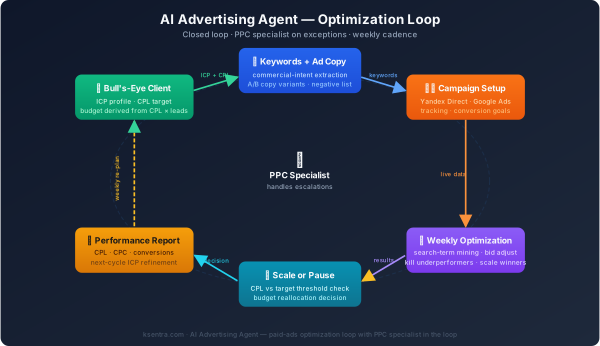
Our AI Advertising Agent runs the full paid-ads operations cycle: identify the bull's-eye client and CPL target, extract commercial-intent keywords, write ad copy variants, configure campaign tracking, launch, then optimize weekly. Each week: search-term mining, A/B tests, bid adjustments, low-impression group cleanup, scale-or-pause decisions against threshold rules.
This is paid-ads operations, not one-off campaign setup. The weekly discipline is where the agent delivers — the work contextologists (PPC specialists) struggle to sustain at quality across multiple accounts.
Budget is derived from CPL × target leads, not set as an arbitrary cap. Yandex Direct is the primary platform for the Russian market; Google Ads when audience profile justifies it. The same AI PPC automation cycle repeats every week without operator burnout.
What You Get
Weekly Optimization Discipline
We mine search terms, kill underperforming keywords, scale winners, and run A/B tests every week. No attention drift, no account-juggling fatigue.
CPL-Anchored Budget
We derive spend from your CPL target × target leads. No arbitrary caps, no wasted budget. The math drives the plan.
Yandex Direct + Google Ads
We operate Yandex Direct as the primary platform for the Russian market and Google Ads when your audience profile justifies the switch. Platform coverage is explicit, not a vague promise.
Click-Fraud Protection
We monitor for click fraud — bot traffic and competitor click-spam that drains budget without producing leads. The agent flags suspicious IP patterns and traffic anomalies for review, and we add exclusions so your spend goes to real prospects, not wasted clicks.
Contextologist in the Loop
Complex bid decisions and edge-case campaign flags go to a paid-ads specialist, Ksentra-side by default as part of your retainer. Optionally, we train your own team to take the expert-in-loop role over time. No campaign decision outside weekly-optimization mechanics happens without a human review.
First External Cohort Access
We're onboarding first external clients now. Direct access to the founder and AI partner, methodology built from 15 years of agency work. Early-cohort clients shape how the agent develops, with full transparency on changes.
Platform Automation vs. Our Agent
Both Yandex Direct and Google Ads ship their own AI. It comes in three layers, separated by how much control you hand over.
Layer one — bid automation (Smart Bidding, auto-strategies) optimizes a campaign already running: it adjusts bids, scheduling, and audience slices toward a goal you set. Useful, and our agent uses it — with one caveat it sets up correctly: auto-strategies need a learning period of one to two weeks of conversion data before they stabilize, so the agent watches them closely through that window rather than trusting them blind.
Layer two — ad generation (Yandex's generative headlines and auto-applied recommendations, Google's responsive search ads and auto-created assets) writes the creative for you. The structure stays yours, but control over what the customer actually reads gets blurred:
- It optimizes the headline for clicks, not for the offer. A generated headline can read well and still drop a key term — price, guarantee, the niche you serve. The click happens; the lead is off-target.
- Brand voice flattens. Generative headlines average out phrasing. For services where trust is built on tone and precision, that erodes the positioning you paid to build.
- A/B testing without you. Responsive ads decide which combinations to show. You see the aggregate, not the hypothesis — what is being tested, and why.
Layer three — fully automated modes (Yandex's Master Campaigns, Google's Performance Max) build the campaign itself from a description of your business. This is where unmonitored budget tends to leak:
- It optimizes the metric it can count, not revenue. Automated modes chase clicks or "conversions" — they cannot tell a qualified lead from a junk one. Budget flows to whoever clicks easily, not to whoever buys.
- The keyword set is machine-built, with no commercial filter. Auto-generated ads pull broad and informational queries — "what is," "how to," "free." Cheap clicks, clean-looking impression stats, and no sales. No negative-keyword list, because no one assembled one.
- No protection against irrelevant traffic or click fraud. Performance Max in particular spends across display, apps, and partner placements you would not choose by hand — and the per-placement report is hard to see.
- A black box with no control point. When cost per lead drifts, an automated mode gives you little to adjust — there is no group structure to act on. The only moves left are to add budget or switch it off.
Our AI Advertising Agent keeps the control point at every layer. It decides which campaign to run, builds the commercial-intent keyword set, designs the ad group structure, and writes the offers itself — three variants per group, against a brief on your offer and brand voice, so the message stays precise. It seeds the negative-keyword list from day one and identifies which channels have gone unprofitable. The difference is one of interest: the platform earns from your ad budget, so it is optimized to spend it; the agent works on your side, so it is optimized to make every dollar reach a buyer. We do not switch platform automation off — we operate it with a control point, covering its blind spots. Cruise control holds a set speed; the driver still chooses the route.
How We Work
Free Consultation
— 30 minWe scope your service offer, target audience, and CPL ambition. We determine whether Yandex Direct, Google Ads, or both are the right starting point.
Bull's-Eye Client + Keyword Research
— 1 weekWe define your bull's-eye client (the exact buyer profile your ads must reach) and extract commercial-intent keywords. Three ad copy variants per group, negative-keyword list seeded from day one.
Campaign Launch
— week 2–3First ad groups go live on Yandex Direct. We set up conversion goals in Yandex Metrica and UTM tagging on every link — these are the events the optimization and auto-strategies train on, so they are not optional. Daily monitoring begins: 48-hour active watch for early anomalies before the weekly cycle takes over.
Weekly Optimization
— ongoingSearch-term mining, A/B tests, bid adjustments. Scale or pause decisions made against your CPL threshold each week. Monthly CPL + ROAS report with recommendations.
Proof: 15 Years of Paid-Ads Delivery
The credential bridge for this agent rests on three verifiable pillars:
- 15-year track record running paid ads for SMB clients — Ksentra digital agency, 2011 to present.
- Live Yandex Direct campaign promoting our AI Chatbot service — launched April 2026, weekly optimization cycle currently running. We walk you through it during the free consultation.
- Transparent methodology — the paid-ads workflow (bull's-eye client → keywords → ad copy → tracking → weekly optimization) is documented and reviewed together in the consultation, not hidden behind a pitch deck.
Current status: methodology proven over 15 years of paid-ads delivery; AI agent build accepting first external cohort. Case studies publishing as engagements close.
Pricing
Price: from $4,250/month Setup: $6,000 one-time — bull's-eye client research, keyword extraction, campaign setup, tracking configuration
Compare: a mid-level PPC specialist in the US costs ~$8,500/month in real cost (salary + payroll taxes + benefits + workplace overhead).
What you get: ✓ Weekly optimization cycle — search-term mining, A/B tests, bid adjustments ✓ CPL-anchored budget — no arbitrary caps, no wasted spend ✓ Yandex Direct primary — Google Ads when audience profile justifies it ✓ Monthly CPL + ROAS report — scale-or-pause recommendations ✓ 24/7 monitoring — no vacation, no sick leave, no burnout ✓ Proven methodology — 15 years of paid-ads agency delivery ✓ Zero payroll overhead — no taxes, no HR, no benefits
Ad spend is separate, derived from your CPL target × target leads.
Frequently Asked Questions
Do I need an AI Advertising Agent or an AI SEO Agent?
Different funnel slots, different timelines. The AI SEO Agent owns the organic-content pipeline — traffic builds over months through published articles compounding in search. The AI Advertising Agent owns the paid-ads pipeline — traffic starts this week, CPL-anchored against your spend. Most businesses need both eventually. Many start with whichever channel has faster proof-of-fit for their offer. If you want both coordinated against shared business OKRs, our AI Marketing Team bundle is the better fit. If you're not yet sure which channel is right and want an advisory conversation first, AI Consulting is the starting point.
What do you need from us to start?
Your service offer with pricing clarity (ad copy needs something concrete to sell), brand voice samples, an ideal-customer profile or willingness to define one in step ②, access to your Yandex Direct account (or we create one), and a CPL ambition — your target cost per qualified lead. Setup takes one week.
How quickly do I see the first campaign live?
Two to three weeks from kickoff: week 1 for bull's-eye client research and keyword extraction, weeks 2–3 for campaign setup, tracking configuration, and launch on Yandex Direct. Weekly optimization starts immediately after launch.
Why $4,250/month — how does that compare to hiring a PPC specialist?
A mid-level PPC specialist in the US costs roughly $8,500/month in real terms — base salary plus payroll taxes, benefits, and workplace overhead. The AI Advertising Agent runs the same weekly optimization cycle at half that cost, 24/7, with no payroll overhead and no sick leave.
Ad spend is separate from the agent retainer. Your ad spend is your money paid directly to Yandex or Google, derived from your CPL target × target leads. We do not bundle media spend into the service fee.
You say "in active development" — what does that mean for me?
The paid-ads work itself is proven over 15 years of Ksentra agency operations and in our live Yandex Direct campaign running right now. The AI agent layer (the component that operates the optimization workflow autonomously rather than through a human contextologist) is in active development. First-cohort clients get direct access to the founder and AI partner, full transparency on how the methodology evolves, and input into what gets built first. For more context on what Gen 3 means in practice: From Tool to Partner — 5 Generations of AI in Business.
Who handles edge cases the agent can't resolve?
A paid-ads specialist handles anything the agent flags: budget anomalies, platform policy issues, audience-targeting decisions that require judgment. Default is a Ksentra-side contextologist included in your retainer. Optionally, we train your own team to handle escalations over time. Nothing is actioned without human review.
What platforms do you operate on, and do we own the accounts?
Primary platform: Yandex Direct (Russian market). Google Ads when your audience profile and budget justify it; other platforms per case scope. Account ownership: your Yandex Direct and Google Ads accounts are yours. We operate them on your behalf — you retain full access and can walk away with the accounts intact. No vendor lock-in.
Yandex Direct and Google Ads already have AI — why do I need yours?
Platform automation optimizes spend; our agent optimizes cost per lead. Platform AI comes in three layers — bid automation, ad generation, and fully automated modes — and each hands more control to a system that earns from your ad budget. Our agent works on your side: it decides which campaign to run, writes the ad copy against your offer and brand voice, cuts what underperforms instead of topping it up, and logs every decision. It also covers blind spots platform automation leaves open — click fraud, unprofitable channels, broad-match traffic with no commercial intent. We do not switch platform automation off; we operate it with control.