
AI transformation is the process of integrating AI systems into your business operations — not as standalone tools, but as components that understand your data, workflows, and objectives. Unlike generic "digital transformation," which often means moving to cloud software or automating spreadsheets, AI transformation changes how decisions get made inside your company.
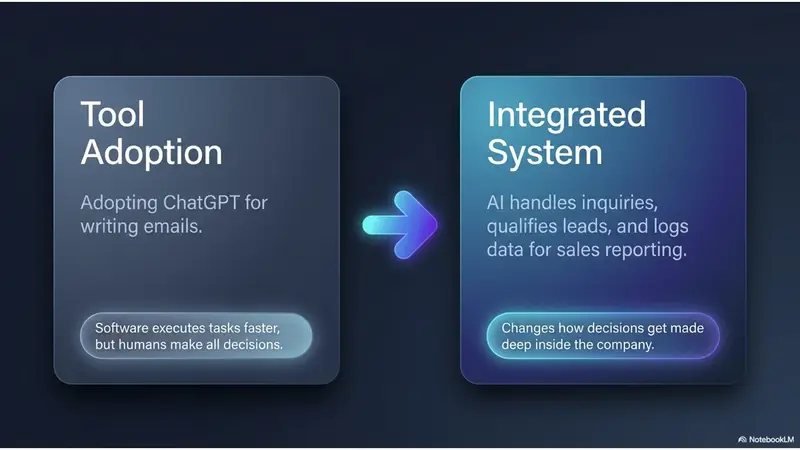
The distinction matters. A business that adopts ChatGPT for writing emails has adopted an AI tool. A business whose AI system handles customer inquiries, qualifies leads, and logs interaction data that feeds into sales reporting and process review has undergone a fundamentally different change. The difference isn't the technology — it's the depth of integration into how the business actually operates.
At Ksentra, we've spent the last year building and operating AI systems at multiple points across this spectrum — from customer-facing chatbots to a strategic AI partnership that co-developed our entire product and content strategy. What we've learned is that most businesses don't need the most advanced AI. They need the right level of AI applied to the right problems. This article explains how to figure out what that means for your company.
Table of Contents
- AI Transformation vs Digital Transformation
- Is Digital Transformation a Prerequisite for AI?
- Why Most AI Projects Fail: It's Not the Model
- The 5 Generations of AI Business Systems
- How to Know Which Generation Your Business Needs
- AI Transformation in Practice
- Getting Started: Your AI Transformation Roadmap
- FAQ
AI Transformation vs Digital Transformation
Digital transformation has been the business buzzword for a decade. It typically means moving from analog to digital: cloud migration, SaaS adoption, process digitization. Important work, but it doesn't change the decision-making structure of your business. Your team still makes all the decisions. The software just makes them faster.
AI transformation goes further. It introduces systems that can make certain decisions autonomously — within boundaries you define. The key question shifts from "how do we digitize this process?" to "how deeply should AI participate in this business area?"
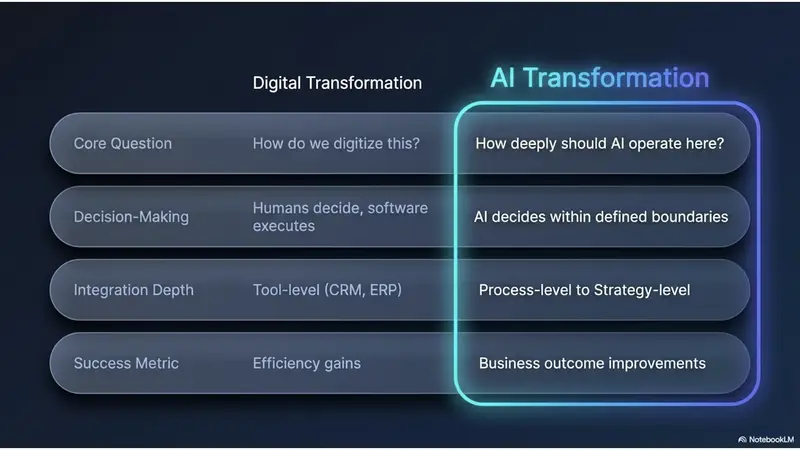
Here's a practical way to think about it:
| Digital Transformation | AI Transformation | |
|---|---|---|
| Core question | "How do we digitize this?" | "How deeply should AI operate here?" |
| Decision-making | Humans decide, software executes | AI decides within defined boundaries |
| Integration depth | Tool-level (CRM, ERP, cloud) | Process-level to strategy-level |
| Success metric | Efficiency gains | Business outcome improvements |
| Failure mode | Over-spending on tools nobody uses | Applying wrong AI depth to the problem |
Is Digital Transformation a Prerequisite for AI?
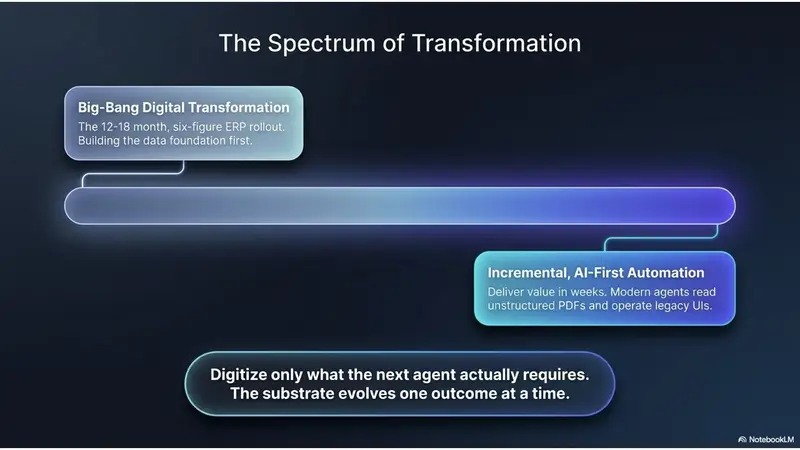
The consultant playbook says yes: clean your data, integrate your systems, then layer AI on top. In SMB practice, that usually translates into an ERP or CRM rollout — a 12–18 month, six-figure project before any AI value lands. McKinsey's 2025 guidance on agentic AI reinforces this: build data foundations first, embed MLOps, then deploy agents. The logic was correct in the pre-LLM era, when ML really did need clean structured training data and APIs to operate.
But the question itself is wrong. Digital transformation isn't a binary — it's a gradient. Every business already runs on some digital substrate: accounting software, a CRM or a spreadsheet, contracts in Drive, knowledge in people's heads and Slack threads. The honest question isn't "have we done DT?" — you have, partially, like everyone else. The question is how far from ideal your substrate is, and whether closing that gap is worth a platform project or worth one agent at a time.
That reframe matters because modern AI agents don't need a finished gradient to deliver value. They read PDFs, screenshots, and unstructured documents natively. Computer-use agents operate legacy software through its existing UI without API rebuilds. Internal tools that used to take six-month projects now take days. You digitize only what the next agent actually requires — and the agent generates structured data on the way that makes the next agent easier.
The honest version of the consultant view still holds for three things: process clarity, source-of-truth for facts, and outcome measurement remain prerequisites. AI can't automate a decision nobody can articulate, and hallucination risk means some canonical data must exist. But those are lightweight requirements — a Notion page and a metric, not an ERP rollout.
The real choice isn't "AI vs no AI" or "DT first vs DT later." It's big-bang digital transformation vs. incremental, AI-first automation — pushing the substrate forward where the next outcome demands it, instead of pre-planning the entire gradient. That delivers value in weeks, not after an 18-month platform rollout maybe pays off. The DT Prerequisite Myth →
So having digital tools doesn't mean you're ready for AI — and lacking a finished ERP doesn't mean you're not. The gap between "we use Slack and Google Docs" and "AI runs our customer service pipeline" is real, but it's bridgeable one outcome at a time.
Why Most AI Projects Fail: It's Not the Model
S&P Global's 2025 enterprise survey found that the share of companies abandoning most of their AI initiatives jumped from 17% in 2024 to 42% in 2025 — a yearly doubling. The reasons cluster into four causes, none of them about the model itself — and all four turn out to be the same root failure in different clothing.
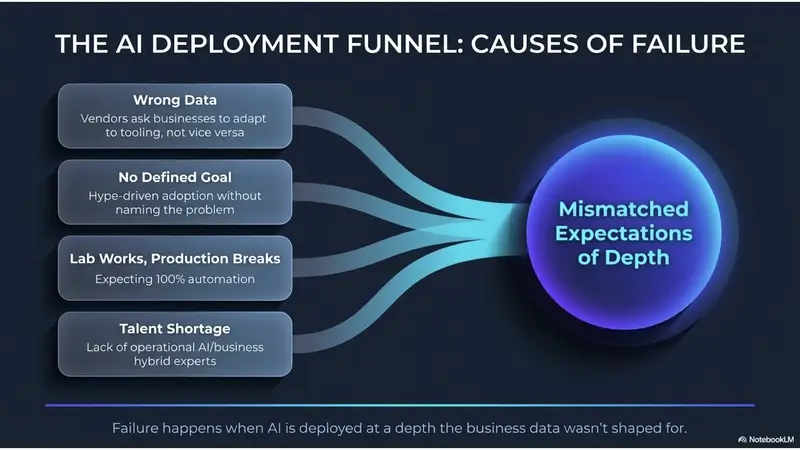
1. Wrong data. The standard AI consultant answer is: clean your data, build a warehouse, then deploy AI. Our answer is to ask why the data is in this shape. Modern LLMs read PDFs, spreadsheets, and mixed-format records natively. When a vendor says "your data isn't AI-ready," they often mean their tooling can't adapt to your data, so they're asking your business to adapt to their tooling. The right direction is the opposite: AI should be adapted to use your business data, not the other way around. Wrong data is almost always a symptom of an AI built at a depth the business data wasn't shaped for.
2. No defined business goal. Companies adopt AI for the hype, without naming the specific problem it's supposed to solve. The result is impressive demos that never become operational systems. Naming the problem first is exactly what the 5 Generations framework forces you to do — a chatbot solves a dialog problem, an agent solves a process problem. Without that decision, no goal can be defined.
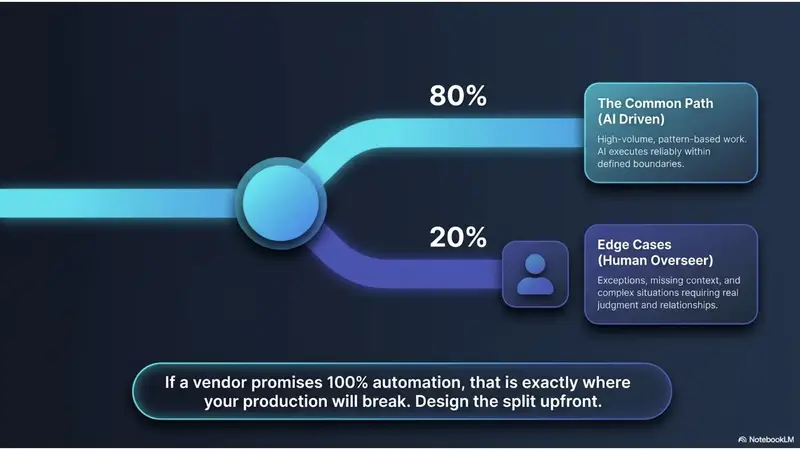
3. Lab works, production breaks. Projects perform well on test data and fail when real workflows hit them with edge cases, exceptions, and missing context. The cause is the wrong expectation that AI must handle 100% of the flow. Real systems are 80/20 — AI handles the common path, humans handle edges. Designing the split upfront is part of choosing the generation.
4. Talent shortage. Operating AI in production — handling drift, escalations, accuracy monitoring, retraining — requires people who understand both the technology and the business process. Most companies don't have them; most AI vendors don't either. The realistic answer isn't to hire ten-year experts in a frontier field that didn't exist five years ago. It's to work with a partner who has done it before and grow internal capability alongside.
All four pitfalls share one root: mismatched expectation about what AI is supposed to do, at what depth, with what division of labor between AI and humans. The 5 Generations framework exists to set that expectation correctly from the start — name the depth, name the goal, design the 80/20 split, and decide what capability you build internally versus partner for. That's how it turns four common ways AI projects fail into a structured choice.
The 5 Generations of AI Business Systems
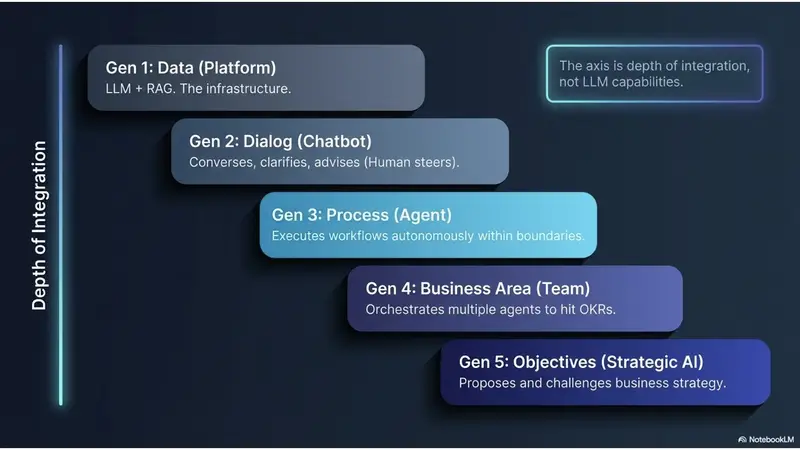
We developed a framework for using AI for business that classifies systems by their depth of business integration — not by features, capabilities, or buzzwords. Each generation represents how much business context the AI system receives and what scope of decisions it's authorized to make.
| Generation | Depth | What It Knows | What It Does | Example |
|---|---|---|---|---|
| Gen 1: AI Platform | Data | Your data via LLM + RAG | Technical foundation for all higher systems | Company knowledge base with AI search |
| Gen 2: AI Chatbot | Dialog | Data + conversational context | Converses, clarifies, advises through dialog | Customer service chatbot |
| Gen 3: AI Agent | Process | Workflow scope, resources, KPIs | Executes complete workflows autonomously | SEO content pipeline agent |
| Gen 4: AI Team | Business area | Business area OKRs | Orchestrates multiple agents to hit targets | Marketing director AI (emerging) |
| Gen 5: Strategic AI | Objectives | Strategy, risks, market signals | Proposes and challenges business objectives | Executive AI advisory partnership |
The axis is depth, not LLM Capabilities. Gen 2 isn't a "worse" version of Gen 3 — it's the right answer for different problems. A customer service chatbot that handles inquiries through dialog doesn't need process-level integration. Adding it would waste money and increase complexity.
LLM Capabilities don't define generations. A Gen 2 chatbot can have persistent memory, API access, and multi-channel deployment. A Gen 3 agent needs those same capabilities to execute workflows. What separates them isn't the feature list — it's whether the system operates at dialog depth (human steers) or process depth (agent executes within boundaries).
For a deep dive into each generation with case studies, read our complete guide: From Prompt to Partner: 5 Generations of AI in Business.
How to Know Which Generation Your Business Needs
Whether you're starting from scratch or rebuilding after a project that didn't deliver, the question is the same: which generation matches the business problem you're solving? The right generation depends on what you're trying to achieve, not on what sounds most impressive. Here's a practical assessment:
Start with Gen 2 (AI Chatbot) if:
- You have a customer-facing process that requires answering questions across a large knowledge base (30+ products, complex pricing, multi-language support)
- Your team spends significant time on repetitive inquiries that follow patterns
- The human needs to stay in control of the outcome — the AI helps them get there faster
- You want results within 4-8 weeks with proven technology
Typical ROI: Reduced response time, 24/7 availability, consistent quality across all interactions. Our Royal Finance case study shows this in practice — a hybrid AI chatbot handling 30+ loan products across two languages.
Move to Gen 3 (AI Agent) if:
- You have a well-defined process with clear inputs, outputs, and quality criteria
- The process is currently executed by a person following documented procedures
- Volume is high enough that inconsistency and bottlenecks cost real money
- You're comfortable with AI executing the process, with human oversight at key checkpoints
Typical ROI: Process throughput increase, consistent quality at scale, staff freed for higher-value work. At Ksentra, our own AI agent handles the entire SEO content pipeline — from keyword research through writing, multi-critic review, and distribution.
Consider Gen 4-5 when:
- You already have multiple Gen 3 agents operating in the same business area
- Coordinating between agents manually has become a bottleneck
- You need the AI to adjust agent parameters based on business area KPIs (Gen 4)
- You want AI input on strategic direction — what objectives to pursue, not just how to pursue them (Gen 5)
Reality check: Gen 4 and Gen 5 are emerging. At Ksentra, we operate a working Gen 5 prototype (our AI partnership that co-developed this entire strategy), but these are not off-the-shelf products. For most businesses, the opportunity right now is in Gen 2 and Gen 3 — proven technology with clear ROI.
Don't Skip Gen 1
Every AI system runs on Gen 1 infrastructure — LLM deployment, RAG pipelines, prompt engineering, and data integration. If your company data lives in scattered spreadsheets, PDFs, and people's heads, no amount of AI sophistication will help. The first step in any AI transformation is getting your knowledge base structured and accessible.
AI Transformation in Practice
Here are two real projects at different depths.
Example 1: Royal Finance — Gen 2 AI Chatbot
The problem: A financial services company offering 30+ loan products needed to handle customer inquiries 24/7 across Russian and English. Human operators couldn't scale, and simple FAQ bots couldn't handle the product complexity.
What we built: A hybrid AI chatbot using Django + YandexGPT (Russian) / GPT-4o (English). Rule-based routing handles compliance-critical product matching. The AI layer manages the conversation — understanding customer situations, recommending products, collecting contacts.
The depth: This is clearly a Gen 2 system. The chatbot talks to customers — converses, clarifies, advises. But every action beyond the conversation (applications, documents, follow-ups) requires human involvement. That's the right level of integration for this use case.
The result: 24/7 multi-language support across 30+ products. The chatbot handles the high-volume inquiry layer, significantly reducing pressure on the human team and freeing operators for complex cases that require real judgment.
Read the full case: Royal Finance AI Chatbot →
Example 2: Ksentra SEO — Gen 3 AI Agent
The problem: Producing consistent, high-quality SEO content at scale requires a pipeline — keyword research, competitor analysis, writing, multi-critic review, revision, and distribution. Each step has quality criteria. Doing it manually creates bottlenecks and inconsistency.
What we built: An AI agent (Claude Code + custom skills) that executes the entire SEO content pipeline. The agent operates within defined process scope with quality KPIs: review scores of 7+/10, keyword density targets, and content standards documented in a 30-page writing guide.
The depth: Gen 3 — process-depth integration. The agent gets scope, resources, and KPIs as input and executes. It doesn't decide what to write (that's the strategic layer above it). When it encounters something outside its defined scope, it escalates rather than attempting recovery on its own. It executes the process reliably.
The result: A content pipeline that produces articles meeting quality standards consistently, with human oversight at strategic decision points. This article was produced through that pipeline.
Getting Started: Your AI Transformation Roadmap
A successful AI transformation strategy isn't a single project — it's a staged process. Here's how we recommend approaching it:
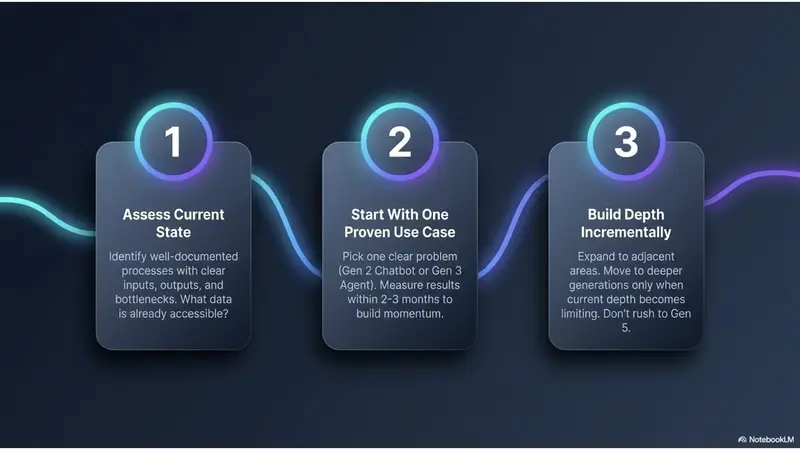
Step 1: Assess Your Current State
Before choosing technology, understand which business areas are candidates for AI integration and at what depth. Key questions:
- Which processes are well-documented with clear inputs and outputs?
- Where do bottlenecks and inconsistencies cost real money?
- What data is already structured and accessible?
- Which decisions could AI make within defined boundaries?
An AI strategy consultation can map this systematically — identifying quick wins (Gen 2) and longer-term opportunities (Gen 3+).
Step 2: Start with One Proven Use Case
Don't try to transform everything at once. Pick one business area where:
- The problem is clear and measurable
- Gen 2 or Gen 3 technology is proven for this use case
- You can measure results within 2-3 months
- Success creates momentum for the next project
For most SMBs, the first project is either a customer-facing chatbot (Gen 2) or a process agent for a well-defined workflow (Gen 3).
Step 3: Build Depth Incrementally
Once the first system is working and delivering results:
- Expand to adjacent business areas at the same generation
- Consider moving to the next generation for areas where the current depth is limiting
- Build the infrastructure (Gen 1) that enables future projects
- Document what works — your AI transformation playbook becomes a competitive advantage
The goal isn't to reach Gen 5 as fast as possible. The goal is to apply the right depth of AI for business operations in each area, based on what actually delivers results.
Frequently Asked Questions
Why do most AI projects fail?
Industry surveys consistently report 40–80% AI project failure rates, and the causes cluster into four: poor data quality, no defined business goal, integration breaking in production, and talent shortage. None of them are about the AI model itself. All four turn out to be the same root failure — a mismatch between what the business expected AI to do and the depth at which AI was actually deployed. A chatbot can't fulfil a process; an agent without process clarity has nothing to execute. The fix is to name the right depth (which generation of AI system fits the problem), define the 80/20 split between AI and humans, and decide what capability you build internally versus partner for.
How long does AI transformation take?
It depends on the scope. A Gen 2 chatbot can be built and deployed in 4-8 weeks. A Gen 3 agent for a complex workflow takes 2-4 months including supervised launch. Full transformation across multiple business areas is a 6-12 month journey. We recommend starting with one proven use case and expanding based on results.
How much does AI transformation cost?
Costs vary by generation and complexity. Gen 2 chatbot projects typically range from $3,000-15,000 for initial build plus ongoing maintenance. Gen 3 agent projects start at $5,000-20,000 setup with outcome-based ongoing fees. The key is that costs should be measured against results — a chatbot that handles 80% of customer inquiries has clear ROI.
Do I need to replace my existing software?
No. AI transformation builds on top of your existing systems, not instead of them. Gen 1 infrastructure connects to your current data sources (CRM, documents, databases). Gen 2-3 systems integrate with your existing workflows. You don't need to migrate anything — you need to make your existing data accessible to AI.
An AI vendor told me our data isn't AI-ready. Are they right?
Sometimes — but more often, it's a deflection. Modern LLMs work natively with the data formats most businesses already have: PDFs, spreadsheets, mixed-format records, even contradictory sources. When a vendor says your data isn't ready, the right response is to ask why, and what specifically would need to change. If the answer involves a six-month data warehouse rebuild before any AI value lands, the vendor is asking your business to adapt to their tooling — when modern AI should be adapted to your business data instead. Real data prerequisites are lighter than vendors typically claim: a canonical source for facts the AI will be authoritative about, plus a clear definition of what "correct" means for the specific decisions the AI is making.
What's the difference between AI transformation and just using ChatGPT?
Using ChatGPT (or any AI tool) is like using a calculator — helpful for individual tasks, but it doesn't change how your business operates. AI transformation integrates AI into your business processes so it understands your data, follows your workflows, and makes decisions within boundaries you define. The difference is between an employee using a tool and a system that operates as part of your business.
Is AI transformation only for large companies?
No — and in many ways, SMBs have an advantage. Large enterprises face bureaucracy, legacy systems, and change management challenges that slow AI adoption. An SMB with $1M+ revenue, well-documented processes, and a decision-maker who understands the opportunity can implement Gen 2-3 systems faster than most enterprises implement Gen 1.
How do I know if my business is ready for AI transformation?
Readiness comes down to three conditions: (1) your key business data is digitized and accessible, (2) you have at least one well-defined process with clear inputs, outputs, and quality criteria, and (3) you have a specific business problem where AI integration would deliver measurable results. If you're unsure, an AI readiness assessment can identify your starting point.
What happens if the AI makes mistakes?
Every AI system we build includes human oversight at appropriate checkpoints. Gen 2 chatbots escalate complex cases to humans. Gen 3 agents escalate exceptions outside their defined scope. The goal isn't zero mistakes — it's reliable performance within boundaries, with clear escalation paths when the AI encounters something outside its scope.
Can AI transformation work for service businesses, not just tech companies?
Service businesses often have the most to gain. They rely heavily on human processes that follow patterns — customer inquiries, proposal generation, scheduling, quality checks. These are exactly the processes where Gen 2-3 systems deliver the strongest results. Our work spans financial services, professional services, and digital agencies.
Does AI transformation mean replacing my team?
No — and this concern is one of the most common blockers we encounter. The right framing is division of labor: AI handles the high-volume, pattern-based work so your team can focus on the cases that require real judgment, relationships, and creativity. In the Royal Finance project, the chatbot handles routine product inquiries; the human team handles complex customer situations the chatbot escalates. Neither replaces the other — the combination handles more volume at higher quality than either could alone.
How can I tell if an AI vendor is proposing something that will actually work?
Three questions cut through most sales pitches. First, what depth of integration are they proposing? A vendor who can't answer in terms of dialog vs. process vs. business-area depth is selling technology, not a solution. Second, how much of the data work is genuinely necessary versus their tooling preference? If the proposal includes a major data project before any AI value lands, ask which parts are truly required and which exist because their stack needs them. Third, what's the 80/20 plan? Any honest AI deployment leaves edge cases for humans — if the pitch promises 100% automation, that's where production will break.
AI transformation isn't about having the most advanced AI. It's about applying the right depth of integration to the right business problems. Whether that's a chatbot that handles customer inquiries or a strategic AI partnership that challenges your business objectives — the framework helps you decide.
At Ksentra, we help businesses navigate this decision — from initial assessment through implementation and ongoing optimization. We've built systems at every generation level, and we use them to run our own company.