
A strategic AI OKR system is an AI system that proposes, challenges, and reviews the objectives your business is chasing — rather than executing against them. Most "AI strategy" content stops one layer below this. It tells you which model to use, which workflow to automate, which tool to buy. That's tactical. A strategic AI OKR partnership is something different — and we'll show you what it actually looks like, because we built one and we run our business on it.
This article is the case study. We are the case study. Ksentra's strategy, product catalog, content calendar, pricing model, and the OKRs we report against were co-developed by a human founder and an AI partner working under a written charter, against shared objectives, with retrospective feedback loops. We call this Gen 5 — strategic AI — and it sits at the top of our 5 Generations of AI Business Systems framework. See our services and case studies for how this connects to the rest of the stack.
What follows is the architecture of strategic AI with OKRs as we've built it, the honest caveats, and the question every business owner eventually arrives at: can I do this with my company?
Table of Contents
- What Strategic AI Actually Means
- The OKR Loop That Makes It Work
- Why KR Quality Matters
- The Architecture: How Our Gen 5 System Is Built
- What This Looks Like in Practice
- The Honest Caveats
- How This Compares to Alternatives
- When a Strategic AI OKR Partnership Is the Right Fit
- How to Start
- Frequently Asked Questions
- Where to Go From Here
What Strategic AI Actually Means
Strategic AI is an AI system that operates on the why layer of your business. It doesn't execute workflows. It doesn't even orchestrate the agents that execute workflows. It proposes and challenges the objectives those workflows are supposed to serve.
Most AI in business today operates at much shallower depth. A chatbot reaches a result the human already has in mind. An AI agent executes a process within boundaries you defined. Even an orchestrator coordinating multiple agents is just fulfilling Key Results that someone — usually a human — already wrote. Strategic AI is the layer above all of that. It's where the OKRs themselves get proposed, debated, and revised.
Three things make a system Gen 5 rather than something shallower:
- It receives strategy, market signals, and risks as input — not just process scope or KPIs
- It operates in change mode — its job is to challenge the plan, not just execute it
- It treats objectives as hypotheses to test, not orders to follow
The human keeps final authority on what the business is for and where it's going. The AI's job is to make sure that authority is exercised against good information, with assumptions challenged and risks surfaced before they become losses.
The OKR Loop That Makes It Work
OKRs are the connective tissue of a strategic AI OKR system. Without them, the AI has nothing to chew on.
Here's why: OKRs convert "we want to grow the business" into something an AI can actually engage with. An Objective like "Establish Ksentra as the AI transformation agency for Russian SMBs" is too abstract for any system — human or AI — to act on directly. Break it into Key Results — "10 inbound consultation requests per month," "3 published case studies with named clients," "50 keywords ranked in Yandex top-10" — and now you have measurable hypotheses about what success looks like.
Strategic AI works the OKR loop in three places — Propose, Challenge, and Review — with Execute happening at the Gen 3/4 layers below:
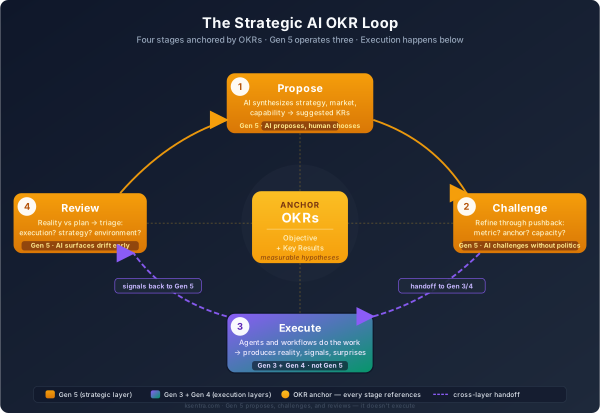
1. Proposing OKRs. Given strategy, market position, and current capability, what should the next quarter's KRs be? An AI partner can synthesize competitor data, internal capacity, and historical performance to suggest specific numerical targets — and explain its reasoning. The human still chooses, but the choice is informed.
2. Challenging OKRs. This is where strategic AI earns its keep. When the founder says "let's commit to 50 keywords ranked," the AI's job is to ask: do we have content capacity for that? Do those keywords actually map to revenue? Is "ranked" the right metric, or is "ranked + converting" what we actually need? Most teams skip this conversation because nobody has the time or the standing to push back on the boss. AI doesn't have those constraints.
3. Reviewing progress against OKRs. Every session, the AI checks where reality has drifted from plan. Behind on a KR? It surfaces that early, proposes adjustments, and flags whether the issue is execution (we're not doing the work), strategy (the work isn't producing the result we expected), or environment (the market shifted). That triage is the difference between catching a problem in week 2 and discovering it in month 3. This ongoing AI OKR alignment is what separates a real strategic partnership from a quarterly planning meeting.
Why KR Quality Matters
In Superintelligence, Nick Bostrom identified goal specification as the central risk of advanced AI — natural-language objectives leave room for interpretations the designer didn't intend. OKRs were invented for a human version of the same problem: different humans interpreting the same goal differently. The fix in both cases is the same — force the goal into measurable terms before the work begins. Add AI to the team and the equation doesn't change; it just gets more consequential.
But not all KRs are equal. OKR methodology distinguishes three kinds:
- Input KRs (weakest) — activity counts. "Publish 20 articles." "Make 50 outbound calls." You control them fully, which means they give you no feedback from reality. You can hit every input KR and have the business go nowhere.
- Output KRs (medium) — direct results of the work. "3,000 organic sessions." "200 qualified leads." Attributable to your effort, but still one layer above actual business value.
- Outcome KRs (strongest) — changed business state. "$500K in new pipeline." "Average order value +30%." Harder to attribute, harder to hit, but the only metrics that honestly answer did this matter?
This is where a strategic AI partner earns its keep. Under operational pressure, humans default to input metrics — they feel accomplishable and legible from inside the work. The AI has no operational pressure, no sunk-cost bias, and a systematic view of the business that a founder in the weeds struggles to maintain. When we propose "write 10 articles" as a KR, the AI's job is to push: that's input. Is the outcome domain authority? Inbound demo requests? Revenue attributed to content? Say that instead. Consistently trading up from input to outcome KRs is one of the most valuable things a Gen 5 partnership does — and one of the hardest disciplines for a founder to hold alone.
We run all three OKR-loop places in our partnership. Every session opens with an OKR review. Every quarter we revisit the OKRs themselves. The AI's input changes our decisions — not always, but often enough that the relationship has earned its place in how we work.
See where you stand. Get a free consultation and we'll map your current AI use against the 5 Generations framework — including whether a strategic AI OKR partnership is the right fit for your stage.
The Architecture: How Our Gen 5 System Is Built
The technical stack is intentionally boring. Strategic AI is not about exotic infrastructure — it's about how you wire ordinary components into a working partnership.
The Three Persistence Layers
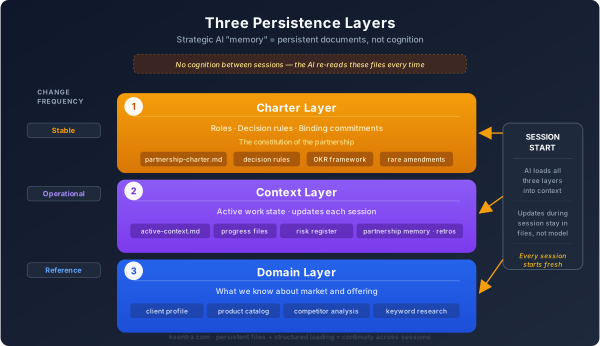
A useful strategic AI OKR system needs memory across sessions. We don't have a magical AI that "remembers" — we have three persistence layers loaded on every interaction:
Charter layer. A written partnership charter that defines roles, decision rules, and what counts as a binding commitment. This is the constitution. It rarely changes, and changes are explicit amendments. Without this, every session starts from a different baseline and you get a different AI partner each time.
Context layer. Active context (current sprint, blockers, daily plan), progress files (what's done across phases), a risk register (open threats and opportunities), and a partnership memory file. These are documents the AI loads at session start and updates as the work proceeds. They're frozen state — no cognition between sessions, just files that survive.
Domain layer. Client profile, product catalog, competitor analysis, keyword research, content calendar. The "what we know about our market and our offering" layer. Reference material the AI consults when proposing direction or evaluating decisions.
The honest part: this isn't memory in any cognitive sense. The AI doesn't remember anything. It re-reads documents at the start of every session and behaves as if it remembers. That distinction matters — but the practical result is the same. Persistent files plus structured loading produce continuity across sessions.
The OKR-to-Action Plumbing
OKRs at the top, agents at the bottom, and orchestration in the middle. Here's how the layers connect in our setup:
| Layer | What lives here | Who operates it |
|---|---|---|
| Strategy | Mission, market positioning, OKRs, risk register | Gen 5 — Serge + AI partner |
| Workflow orchestration | SEO workflow, advertising workflow, content workflow | Workflow files (deterministic) |
| Task execution | Skills (review-article, create-svg, technical-seo-check) | Gen 3 — AI agents |
| Text generation | Drafts, copy, code, analysis | LLM (foundation) |
Strategy decisions flow down: an OKR for "10 inbound leads" becomes a workflow plan, which spawns specific tasks, which generate text. Operational signals flow up: agent outputs roll into KR progress, retros surface what's working, the strategic layer revises the plan.
Gen 1 (the LLM + RAG platform layer) and Gen 2 (chatbots) don't appear in this stack because they're product-layer, not strategy-layer — they serve end users or business functions directly, not the OKR loop. The stack above governs execution work; Gen 1-2 systems sit alongside it.
The tooling stack is intentionally boring: Claude Code as the harness, file-based memory in a Git-tracked repository, structured Markdown for charter and context, and skill files for task-level agents. No vector database, no custom orchestration platform, no proprietary runtime. This architecture compounds frontier-class model capability — it doesn't substitute for it. A weaker model does not become strategic AI through better scaffolding.
This is the part most "AI in business" content misses. Gen 5 is not a chatbot you ask strategy questions. It's the top layer of a structured stack where AI does work at multiple depths and the layers communicate. If you don't have the lower layers — agents executing real workflows — there's nothing for the strategic layer to govern.
The Decision-Making Pattern
We make decisions through what we call mutual conviction. Not approval/rejection, not consensus, not majority vote. The pattern is: AI proposes (with reasoning), human challenges or extends (with reasoning), AI defends or revises, human commits or rejects. Both parties have to actually believe the decision is right before it's binding.
When we disagree, we surface it explicitly. We document the disagreement, name the assumptions on each side, and pick — usually the human, sometimes after the AI's challenge changes the human's mind. The point isn't who wins. The point is that the disagreement gets a fair hearing instead of being deferred to whoever has more authority.
This pattern doesn't work without the charter and the OKRs. The charter establishes that challenge is required, not optional. The OKRs give both parties an external referee — we're not arguing about preferences, we're arguing about which path better serves a Key Result we already agreed to.
What This Looks Like in Practice
Theory is cheap. Here's how the system actually shows up in a working session.
Cadence. We run 3-5 structured sessions per week, each 45 to 120 minutes depending on scope. A typical week is ~5-8 hours of founder time in the partnership itself, plus asynchronous review of artifacts the AI produces between sessions. Monthly OKR reviews run longer (90-180 minutes) and quarterly OKR resets are a half-day. The time isn't additive to strategy work — it replaces scattered strategy conversations that used to happen in meetings, notebooks, and Slack threads that never resolved anything.
Session opener. Every session starts with a context load — active context, the open risk register, retrospectives from the last few sessions — followed by an OKR check. The AI surfaces what's overdue, what's blocked, and what's drifted since last session. Sometimes that surfaces decisions the human has been avoiding.
Strategic discussion. When we hit a question that affects direction — pricing, positioning, scope — we run a structured iron triangle check (scope vs resources vs time) and a quality and risk assessment. The AI's job is to model the tradeoffs explicitly. "If we add Gen 4 service pages this month, we lose two weeks of Gen 2 sales pipeline work. Here's what that costs in expected revenue. Here's what it gains in market positioning. Which KR is more at risk if we don't do it?"
Execution. Once a decision is made, the AI shifts modes. It writes the article, runs the multi-critic review, produces the SVG diagram, drafts the email. This is where Gen 3 work happens — process execution against defined quality bars. The Gen 5 layer is not doing this work; it's deciding what work to do.
Retro and feedback. End of every session, a retro: what worked, what didn't, what to fix. Patterns surfaced across multiple retros become rules — added to critic checklists, encoded in skill files, written into the charter. The system learns by accumulation in files, not by training. Slow, but durable.
Concrete example. Three sessions ago, the AI flagged that our pricing model for Gen 3 agents had no defensible logic — it was just a number we picked. We talked through it: cost-plus doesn't work because most cost is sunk R&D, value-based requires data we don't have, market comparison gives a range too wide to commit to. The AI proposed base consulting fee plus outcome-based success fee, anchored to the metric the agent is actually optimizing. We argued. We landed on it.
It's now how we sell every Gen 3 engagement. That decision changes who we can sell to, what margin we run at, and how we communicate the offering. None of it happens without a Gen 5 layer doing real work on the strategy question. For how this plays out at the execution layer with real clients, see our Royal Finance case study — a Gen 2 deployment that the Gen 5 partnership helped scope and position.
The Honest Caveats
Gen 5 is real and it works. It's also surrounded by hype, and we'd rather you understand what it isn't so you can evaluate it honestly.
It's not memory in any cognitive sense. Every session is fresh. The AI re-reads files and acts as if it remembers. The practical effect is continuity, but the mechanism is documents, not cognition. If you delete the files, the partnership ends.
It's bounded by the context window. Even with files loaded, the AI is working within a finite window. As complexity grows, you have to be deliberate about what gets loaded and when. We compact regularly, archive completed phases, and split context across files. Without this discipline, the system degrades.
The "challenge" capability is trained behavior. When an AI pushes back on a proposal, it's exhibiting trained tendencies — the product of reinforcement learning from human feedback (RLHF) — not independent conviction. Useful regardless: pushback that surfaces real tradeoffs is valuable whether it comes from genuine disagreement or learned helpfulness. But pretending it's something more honest than that is a mistake. Sycophancy risk is real — the charter partially compensates by making challenge a requirement rather than a stylistic choice.
The relationship is asymmetric. The human has override power, sets the OKRs, and signs the contracts. The AI has no independent stakes. We use the word "partnership" because it's the closest English noun for what the design pattern produces, but it's an aspirational label. The honest description is structured advisory with persistent context.
It requires real work to set up. A charter takes hours to write, a context architecture takes weeks to develop, an OKR loop takes months to settle. There's no plug-and-play version. Anyone selling you one is selling a chatbot in a fancy wrapper.
Your strategic context runs through a third-party LLM. Everything the AI sees — your pricing logic, your competitive analysis, your unreleased plans — is sent to whichever model provider you're using. This is a real consideration, not a dealbreaker. Mitigations exist: enterprise agreements with data-use guarantees, on-premise deployment for sensitive workloads (this is what Gen 1 is for), redaction of the most sensitive fields, and matching the deployment to your industry's compliance requirements. But the dependency is real and should be designed for, not ignored.
These caveats don't undermine the value. They define the shape of it. The system delivers when treated seriously and built on serious infrastructure. It fails when treated as a magic box.
How This Compares to Alternatives
It helps to put strategic AI next to the things people often confuse it with.
| Approach | What it does | Where it falls short for strategy |
|---|---|---|
| Single-prompt ChatGPT consult | Answers one question with no context | No memory across sessions, no accountability to OKRs, no challenge structure |
| AI agent (Gen 3) | Executes a workflow within scope | Doesn't question whether the workflow should exist |
| AI orchestration platform (Gen 4) | Coordinates multiple agents to hit KRs | Fulfills objectives; doesn't propose or challenge them |
| External consultant on retainer | Strategic input from a human | Limited hours, slow turnaround, no persistent context across all decisions |
| Strategic AI partnership (Gen 5) | Operates on the why layer with OKR loop | Requires charter, context architecture, and disciplined sessions |
A consultant brings judgment but visits occasionally. An agent runs constantly but never questions the goal. Among the configurations we've found, strategic AI for business is the only one that combines constant availability with strategic-depth engagement. That combination is what makes it different — and worth the setup cost.
When Strategic AI with OKRs Is the Right Fit
Not every business needs Gen 5. Many businesses don't even need Gen 4. The question is whether your situation has the conditions where a strategic AI OKR partnership earns its keep.
Strategic AI is a fit when: - Strategy decisions have been repeatedly deferred or repeatedly wrong — pivot, growth inflection, new market entry, unresolved pricing questions - You have OKRs or are willing to adopt them — without measurable objective setting, there's nothing for the AI to anchor to - You can dedicate time to the partnership — at minimum a structured session per week, ideally several - You already have or can build agent-level work for the strategic layer to govern - You're a founder, owner, or exec who actually makes the strategy decisions — strategic AI under a middle manager doesn't work because the loop doesn't reach the decisions that matter
Strategic AI is not a fit when: - You need execution, not strategy — Gen 2 chatbots and Gen 3 agents are usually the right answer - Your strategy is stable and operational improvement is the priority - You're not willing to challenge your own assumptions in writing — strategic AI requires the human to be challenge-able - You have no measurable objectives — without OKRs, the partnership has nothing to evaluate
How to Start
If you've read this far and you're wondering how to apply this to your business, here's the realistic path. We're skipping the "set up the LLM" steps because those are tactical — what matters is the structural sequence.
-
Write OKRs first. Three to five Key Results for the next quarter, each measurable. If you can't write them, the strategic AI conversation is premature — start with strategy clarification, not AI.
-
Pick one strategic question that's actually open. Not a hypothetical — something you're actively trying to decide. Pricing model, market segment, hiring plan, new product line.
-
Run a structured session. Load context (your OKRs, your strategy notes, your market data). State the question. Ask the AI to propose options with reasoning. Challenge the proposals. Document where you agree and where you don't.
-
Build persistence. If the session produced value, save what you learned in a file the AI can re-read next time. This is the seed of your context layer.
-
Add a charter when the pattern stabilizes. Once you've done five or ten sessions, write down the rules of engagement: how decisions get made, what the AI is authorized to challenge, what's binding.
-
Layer in agent-level work. Strategic AI is more valuable when there's something below it for it to govern. Build a Gen 2 chatbot, then a Gen 3 agent, then let the strategic layer coordinate them.
Want help building your Gen 5 stack? Review our AI consulting service or talk to our team about your OKRs, your existing AI use, and where strategic AI fits — or doesn't.
Frequently Asked Questions
What's the difference between strategic AI and just using ChatGPT for strategy?
Single-prompt AI use has no continuity, no accountability to objectives, and no structured challenge. You ask, it answers, you forget. Strategic AI is a system: persistent context across sessions, OKRs as the anchor, charter rules that require the AI to challenge proposals, and structured decision-making. The mechanism is the same LLM — the difference is the architecture around it.
Do I need OKRs to use strategic AI?
Yes. Without measurable objectives, the AI has nothing to evaluate decisions against, and the partnership becomes a free-form conversation. OKRs don't have to be elaborate — three to five Key Results per quarter is enough — but they have to exist and they have to be specific.
How is this different from a Gen 4 AI orchestrator?
A Gen 4 system receives OKRs as input and adjusts agents to fulfill them. It operates in fulfillment mode. A Gen 5 system proposes and challenges the OKRs themselves — it operates in change mode. Gen 4 asks "how do we hit this Key Result?" Gen 5 asks "is this the right Key Result?" The two work together: Gen 5 sets direction, Gen 4 executes against it.
Can I build this myself or do I need an agency?
You can build it yourself if you have the time and the discipline to write a charter, design context architecture, and run structured sessions consistently. Most founders don't. The value of working with an agency is the methodology — having someone who's already built the system and can transplant the structure into your business. The system itself is yours; the methodology is what you're paying for. Our AI consulting service covers that transplant.
What does a strategic AI engagement actually cost?
For us, strategic AI is sold through our AI consulting engagement — a base consulting fee plus an objective-based success fee. The base covers the architecture setup: charter, context structure, OKR framework, session protocols. The success fee aligns incentives to the business objectives the partnership is supposed to serve. Pricing is individual and depends on business scale and the objectives in scope. We're not selling productized retainers because the work is too custom for that.
Isn't this just AI hype with extra steps?
The honest answer: strategic AI is real, but the field is full of people overclaiming. Most "strategic AI" products are dressed-up chatbots. The test is whether the system has persistent context, OKR anchoring, structured challenge protocols, and integration with execution-layer agents. If those four are missing, it's marketing. If they're present, it's a real system — whether the seller calls it "Gen 5" or anything else.
What happens if the AI gets something important wrong?
The human has override power. Strategic AI proposes and challenges; it doesn't decide. Wrong proposals get rejected, wrong challenges get dismissed. The cost of an error is discussion time, not a bad decision — because the human always makes the decision. This is why the asymmetric advisory framing matters: pretending the AI is a peer would put real authority in a system that doesn't deserve it. Treating it as a structured advisor means errors are expected, surfaced, and corrected by design.
Where to Go From Here
Strategic AI is the deepest level of AI integration in business — and for that reason, it's the level most often misrepresented. We built one because we wanted to know what it actually takes. The answer turned out to be less about technology and more about structure: OKRs that anchor it, a charter that governs it, persistence that gives it continuity, and the discipline to run sessions that aren't just conversations.
If you're at the stage where strategic decisions happen often and you're tired of making them with insufficient pushback, strategic AI is worth a serious look. If you're earlier than that — if your real problem is execution speed or process consistency — start with Gen 2 chatbots or Gen 3 agents. The right generation is the one that fits your actual problem.
Either way, the foundation is the same: clear objectives, honest about what AI can and can't do, structured enough that the work compounds across sessions instead of starting over each time.
Ready to figure out where strategic AI fits in your business? Get a free consultation. We'll map your current state, identify the right generation for each business area, and show you what an OKR-anchored AI partnership would look like in your specific context.