
Which Digital Transformation Problems AI Solves — and Which It Worsens
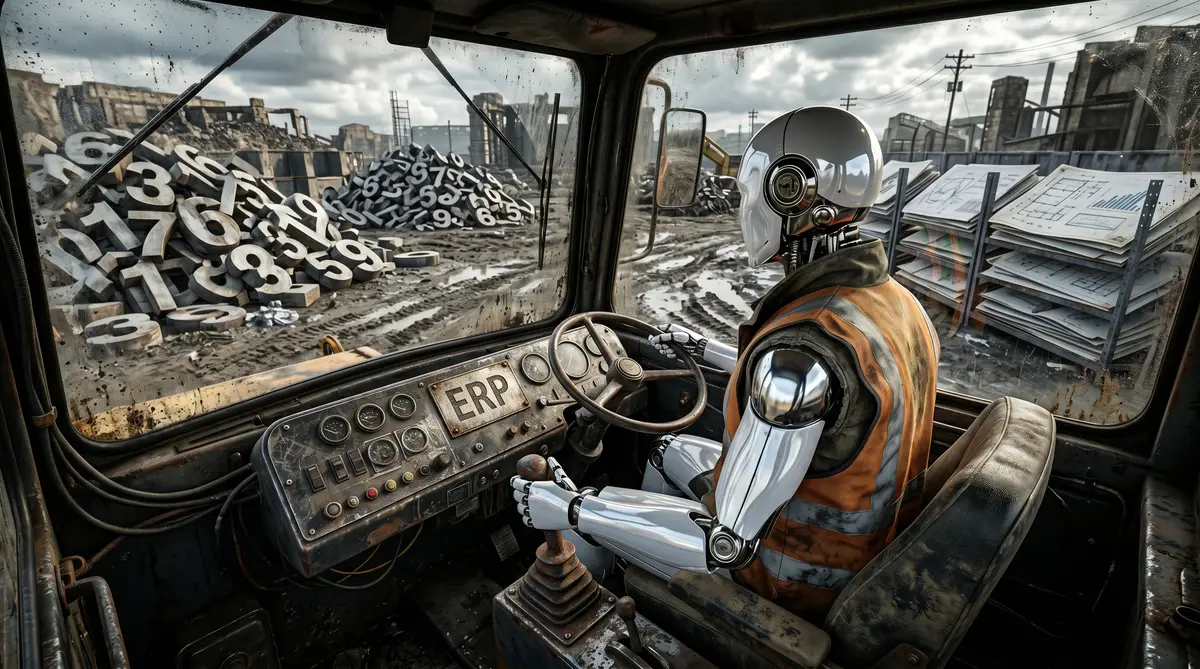
The same transformation gets sold twice. First by a consultant: finish your digital transformation first — clean the data, replace the legacy systems, get the house in order — and only then, once everything is tidy, move on to AI. Then by a vendor, the opposite: don't bother cleaning anything, our AI ingests messy data automatically and you'll be live in days. Both take a deposit. The transformation still stalls.
Both pitches fail for the same reason: each is half-right, and half-right is the most expensive kind of wrong. The market is full of tidy tables promising that AI solves your digital transformation problems — data silos, employee resistance, legacy systems, slow reporting, each with a checkmark and a confident "key business impact." Some of those rows are real. Two of the loudest are false, and believing them doesn't just waste money — it makes the underlying problem worse. This article sorts the list without the gloss: what AI genuinely changes, what it quietly degrades if you trust the brochure, and where a business your size should point it first. (If you want the wider frame first, our guide to what AI transformation actually involves sets the stage; this piece is about the specific problems people expect AI to fix.)
Why "AI solves your transformation problems" is half-right and dangerous
The standard advice arrives as a table. Problem on the left, "AI solves it" in the middle, "business impact" on the right. Data silos? AI unifies them. Employee resistance? AI explains the workflows. Legacy systems? AI wraps around them. Slow analysis? AI predicts. It reads like a solved problem.
The danger isn't that the table is wrong. It's that the table is partly right. A few of those rows describe genuine, mechanical changes AI brings. That accuracy is exactly what lends credibility to the rows that are false — the reader who has seen AI genuinely speed up their reporting is primed to believe it will also clean their data silos in days. It won't. The honest move is not to throw the table out, and not to swallow it whole, but to split it: which rows are real, and which are the ones that quietly cost you the most.
What AI genuinely changes
Start with the wins, because they are real and worth being precise about.
Slow analysis becomes fast, forward-looking analysis. The reports that took an analyst a week — what's selling, where margin is leaking, which customers are about to churn — can now run continuously against live data. This is a genuine change in kind, not just speed: you move from looking backward at last month to watching the present as it moves.
The software nobody could use becomes answerable in plain language. A large part of "employee resistance" was never resistance — it was a system too complicated to operate without a manual. A natural-language interface over a complex tool removes that wall. People who avoided the CRM because it took eleven clicks will ask it a question instead. This is a real change, and it's worth seeing for what it is: not the system getting simpler, but the cost of using it dropping close to zero. The eleven clicks are still there underneath. AI just means a person no longer has to know them — which is genuine, and also a hint about everything else in this article, where "AI handles it" turns out to mean "AI handles the effort, not the underlying thing."
The labor of connecting and deduping data gets cheaper. This is the one that gets oversold, so be exact about what genuinely changes. AI is good at probabilistic matching — spotting that "J. Smith Ltd" and "John Smith Limited" are the same customer across two systems, the tedious reconciliation work that used to eat analyst-weeks.
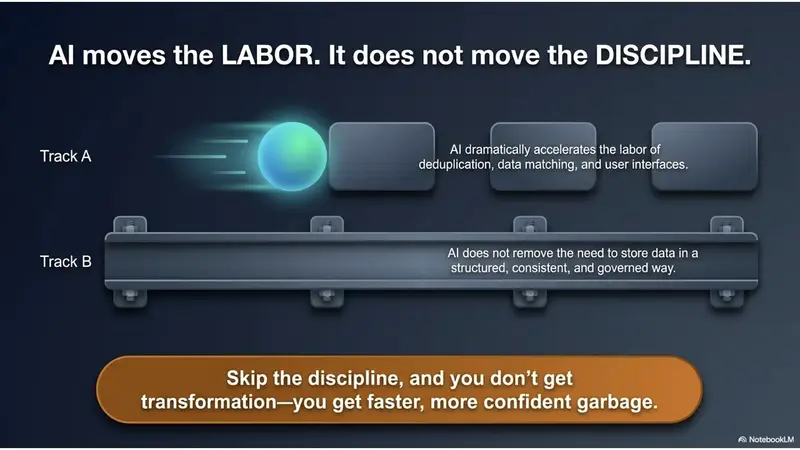
Notice the careful word in that last one: labor. AI moves the labor of pulling fragmented data together. Hold that word, because the next section is about what happens when people mistake "moves the labor" for "removes the work."
What AI quietly worsens if you believe the hype
Two rows on the standard table are not just optimistic. They are false in a way that costs you, and they are the two the loudest vendors lean on hardest.
"AI cleans your data silos in days." No. The realistic goal was never to eliminate the silos — it was to make AI effective despite them. Raw, ingested data is not AI-ready data. Pointing a capable model at an inconsistent, ungoverned data mess does not produce clean insight; it produces confident noise — fluent, plausible, authoritative-sounding answers built on contradictions the model can't see. That is the most dangerous output a business can get, because it's wrong in a way that looks right. (We unpack that failure mode — how AI on a shaky foundation manufactures confident wrong answers — in our piece on AI in business processes.)
"AI modernizes your legacy systems automatically." Also no. AI can put a friendlier surface on a legacy system, and that's useful. But the data model underneath, the governance rules, the access controls you defined — those do not relocate to a magic layer. The constraints that made the system painful are still there; they're just wearing a chat window now.
Here is the principle under both false rows, stated plainly because it's the load-bearing idea of this entire article: AI moves the labor of data; it does not move the discipline. It will help you absorb fragmented sources. It will not relieve you of the need to store data structured, consistent, and governed. Garbage in, garbage out did not get repealed. Believe the brochure, skip the discipline, and you don't get transformation — you get faster, more confident garbage.
The real reason transformations fail — and why AI amplifies it
If AI doesn't fix the data and doesn't modernize the legacy, what actually kills most transformations? Not technology. Around 70% of digital transformations fail to meet their goals, and when you read the post-mortems, the cause is almost always organizational: no clear vision, leadership that won't commit, culture that resists, and a budget that puts barely a tenth of its money into the change-management work that decides whether anyone actually adopts the new way. Poor data quality is on the list, but it sits alongside the human failures, not above them.
This is why AI is an amplifier, not a cure. AI improves a well-defined process and makes a broken one worse, faster. Drop a capable model into a transformation that's failing for organizational reasons and it doesn't reverse the failure — it multiplies whatever is already there. On a healthy, defined process, that multiplication is leverage. On a confused one, it's a faster route to a worse place, now with the authority of "the AI said so." The technology was never the variable that decided the outcome. The clarity of the process you point it at is.
The reframe that turns the bad news into a head-start
So far this reads like discouragement. It's the opposite — for a business your size, it's the most liberating thing in this article.
If AI won't clean your whole company and you don't need to finish a big-bang transformation first, then the entire "get everything in order, then start" project — the one the consultant quoted you for — was never the prerequisite. You do not need an enterprise data warehouse. You do not need to replace your legacy stack. You need a data foundation, not a data warehouse: enough clean, consistent, governed data about one painful, well-defined process to let AI work on that one well. That's a far smaller, far cheaper, far faster thing than "transform the company."
And on this, a smaller business has the advantage. You have no decades of legacy sprawl to fight, you can adopt turnkey tools the enterprise can't move fast enough to use, and the small businesses doing this are growing faster year-over-year than the giants. The barrier for you was never the size of your data problem. It's believing one of two myths: that you must boil the ocean before you start (the consultant's trap), or that AI will boil it for you (the vendor's). Both are false. Avoid both, and the path opens. (This single-process, foundation-first starting point is the same one we argue for at the strategy level in our guide to AI strategy for a business — start where the data is coherent and the pain is real, not where the slide deck says you should be.)
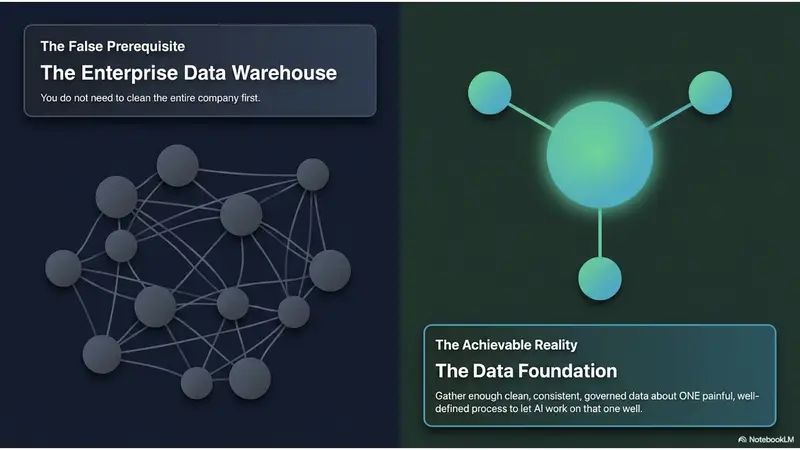
One caution, because this is exactly where the reassurance turns back into hype if you let it. "Enough clean data for the one process" is a real requirement, not a loophole. Making AI effective despite the wider mess still means giving it a coherent, governed slice for the process you've chosen. The discipline doesn't disappear; it just gets small enough to be achievable. You're not skipping the data work. You're doing the smallest honest version of it, on purpose.
Where to point AI first
If you only do one thing with this article, do this. The question is not "what can AI fix?" It's "which of my problems is AI-shaped, and sets up the next one?" Use these filters, in order:
- Is the process defined enough for AI to accelerate it rather than amplify its mess? Practical test: can you draw the happy path and name the main exceptions? If you can't, AI won't fix that — it will run faster in the wrong direction.
- Is the data visible enough? Can AI actually see what it needs about this process, in a coherent form, or is it scattered across places that contradict each other?
- Is it genuinely painful? Worth solving, not just solvable.
- Does its data feed the next thing you'd want to build? Same customers, same records, same entities. The clean slice of data you create solving this problem should be the foundation the next project stands on — not a one-off nobody else will ever touch.
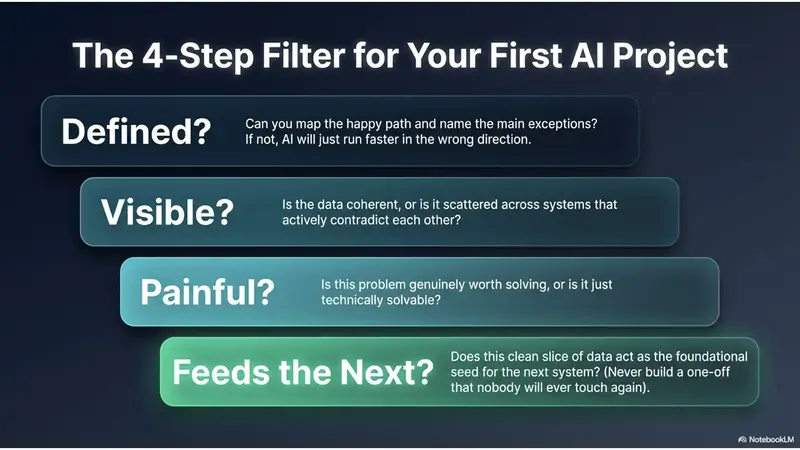
That fourth filter is the one most people skip, and it's the one that compounds. The small, clean data foundation you build for that first process is not just the solution to one problem. It's the seed of everything that comes after — the fixed center the whole system grows around, the thing a later AI agent will stand on once the core is proven. (We map out exactly how a system grows from that seed — one anchored loop at a time, instead of scattering disconnected tools — in our companion piece on the stages of AI transformation as a spiral, not a ladder.) Pick the lowest-effort win whose data the next loop can reuse, and sequence by that adjacency rather than by which task is simply easiest to knock out.
Move the labor, keep the discipline, and own the call
The two pitches that opened this article were mirror images of the same mistake. The consultant said the discipline was a prerequisite you must finish before AI. The vendor said AI would handle the discipline for you. Both were wrong in the same place: they treated the discipline as something to get past. It isn't. It's the thing that stays. AI moves the labor — the dedup, the matching, the slow analysis, the unusable interface. The discipline of structured, governed, coherent data about the process you care about is yours to keep, just at a size you can actually manage.
So the win in 2026 doesn't go to the business with the cleanest data. It goes to the one that stopped treating cleanup as a wall to climb before starting, and didn't believe the AI would do the cleanup for it. That business picks one real, AI-shaped problem, gives AI a coherent slice of data to work on, and builds from there.
The hard part isn't the technology. It's the judgment call: which of your problems is actually AI-shaped, which process is defined enough, and how much data foundation is "enough" for that one. That judgment is the human-in-the-loop work we do — not "we'll clean your data," but "we'll tell you the truth about which problem to point AI at first, and how to sequence what comes after." If you'd rather hear that truth before a vendor sells you a cleanup that never ships, that's where an AI consulting engagement starts. We help you choose the first problem well — and choosing well, once, at the start, is where this whole effort is won or lost.
Frequently asked questions
Does AI clean your data automatically?
No. AI moves the labor of data work — deduplication, probabilistic matching across systems, ingesting fragmented sources — but it does not remove the discipline of storing data structured, consistent, and governed. Raw ingested data is not AI-ready data. Point a model at an ungoverned mess and you get confident, fluent, authoritative-sounding answers built on contradictions it can't see. The cleanup work gets smaller and cheaper; it doesn't disappear.
Do I need to finish digital transformation before using AI?
No, and waiting is the more expensive mistake. You don't need an enterprise data warehouse or a finished systems overhaul. You need a data foundation — enough clean, consistent, governed data about one painful, well-defined process — to let AI work on that one well. That's a far smaller project than transforming the whole company, and it's where a smaller business actually has the advantage over an enterprise drowning in legacy systems.
Why do most digital transformations fail?
Around 70% fail to meet their goals, and the cause is overwhelmingly organizational, not technological: unclear vision, leadership that won't commit, cultural resistance, and underfunded change management (often barely a tenth of the budget). Poor data quality contributes, but it's not the main driver. This is why adding AI to a struggling transformation tends to amplify the problem rather than solve it — AI improves a well-defined process and makes a broken one worse, faster.