
Stages of AI Transformation: Why It's a Spiral, Not a Ladder

Every consultant draws the same picture of AI transformation: a sequence of stages you climb one after another. The roadmaps look authoritative, yet they leave the one practical question unanswered — which stage is a given business actually on? Two situations show why the question itself is the problem.
In the first, a company has a booking chatbot that mostly works and a pilot that half-landed, and is now being quoted a "stage 3" governance and platform project. Nothing in the roadmap tells it whether that project is the right next move or just the next rung on a ladder no one agreed to climb. In the second, a company did the sensible thing: a chatbot for support, an assistant for the sales team, a tool that drafts marketing copy — each a quick win, each justified on its own. A year later it has three AI tools, and not one of them can tell whether the person who just messaged support is the same customer the sales assistant spoke to last week. They share no records at all.
Both situations are the same problem, and the problem is the map. AI transformation stages are usually drawn as a ladder: assess, pilot, scale, govern, optimize, and arrive at some autonomous mountaintop. For a small or mid-sized business that map is wrong — not because the levels aren't real, but because a ladder is the wrong shape. The right shape is a spiral, and what it spirals around is your data. (If the scope of AI transformation itself is still unclear, our guide to what AI transformation actually means for a business is the wider frame; this article is about the shape of the journey through it.)
Why the ladder is the wrong map
The standard AI maturity model assumes everyone is climbing toward the same summit on roughly the same schedule. Six neat stages, each a prerequisite for the next, with "fully autonomous enterprise" waiting at the top. It's a comfortable picture because it turns an open-ended question into a checklist.
For a small or mid-sized business, it's a trap. It tells you that you are "behind," that there is a correct next rung, and that the work is to climb faster. The leading edge of the market has already moved off this framing. The current read among people who actually deploy AI is that maturity is about fit, not climbing — the right depth for the problem in front of you, not the deepest depth available.
The maturity levels themselves are not wrong. An agent genuinely is a more capable thing than a chatbot; a system that touches four processes is genuinely further along than one that touches one. The error is treating the AI adoption stages — a description of how systems have grown — as a prescription for how yours must. The ladder describes where some companies ended up. It does not tell you what to do on Monday.
The real shape: a spiral around your data
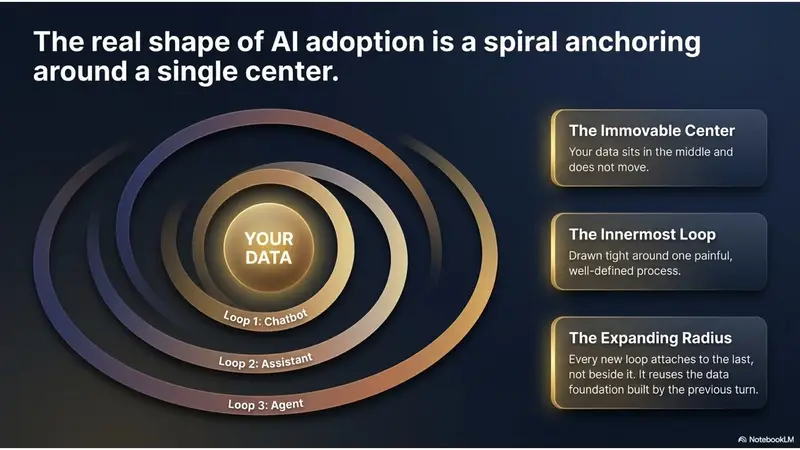
Picture it differently. Your data sits at the center and does not move. The first thing you build — typically a chatbot on one painful, well-defined process — is the innermost loop, drawn tight around that center. It does one job. While it does that job, it proves two things: that the process is real and runnable, and that the data underneath it is good enough to run on. When it's working, it has left behind something small but solid: a clean, real layer of data about that one process. (This is the same point our piece on AI in business processes makes from the other direction: what AI actually does to a single process, before you ever think about a second one.)
The next thing you build is a wider turn of the same spiral. Maybe it adds functions to the chatbot. Maybe it wraps an agent around the proven core so the system can take actions, not just answer. Maybe it reaches an adjacent process — one that shares customers, or records, or entities with the first. Whatever it is, it stays anchored to the same center and reuses what the previous loop built. The data compounds because every loop attaches to the last one, not beside it.
Now hold that picture against the three-tools-that-don't-talk story from the opening. That is what the sensible-sounding alternative produces. "Pick the right depth for each problem and run them in parallel" feels efficient — you're solving real problems, fast. But run in parallel, each with its own little data layer, those projects don't compound. They scatter. You end up with islands: a support chatbot here, a sales assistant there, a copy tool over there, none of them sharing a customer record, probably contradicting each other about the same person. That is not a maturity level. It's sprawl wearing a maturity costume.
The spiral is the alternative to islands. One center, growing radius, every loop reusing the last.
The center is your data, not an ERP
Here is where it gets concrete, because the largest software company in the enterprise world is building exactly this spiral right now — and the way they're building it proves the point for everyone who isn't them.
SAP's 2026 "Autonomous Enterprise" strategy is, structurally, this spiral. Their assistant, Joule, turns ERP screens and forms into conversation. Agents coordinate tasks over a common data layer. All of it reorganizes how a company touches the same data it already holds in SAP. It is a genuinely good architecture — if you already own the ERP.
But read what SAP says about the center of it. Their own materials describe a context layer built to unify SAP and non-SAP data. Even SAP, whose entire business is the ERP, frames the thing the spiral organizes itself around as data, not the ERP specifically. The ERP is just where a large enterprise happens to keep most of its data.
That single admission is the door for a business your size. You never bought SAP, and you don't need to. You are not locked out of the spiral — you build the same shape around the data you already have: your CRM, your accounting system, the spreadsheets that run the part of the business nobody has digitized yet, and the one painful process you're about to point AI at first. You don't need the ERP at the center. You need your data at the center. And you already have data at the center, whether or not you've ever called it a "platform."
This is also why "finish your digital transformation first, then we'll talk AI" is bad advice for you. You do not need a finished transformation or a big-bang systems overhaul before you start. You need a data foundation — enough clean, consistent data about the one process you're starting with — not a data warehouse spanning the whole company.
Maturity is an output, not an input
If the spiral grows around your data, then maturity stops being a plan and becomes a result.
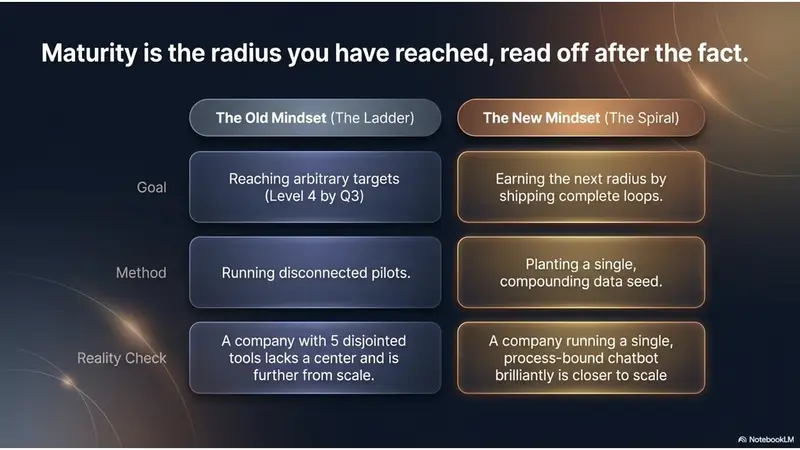
You do not sit down and decide "we will reach level 4 by Q3." You ship one loop. Shipping it well gives you two things you didn't have before: a clean slice of data, and the confidence — earned, not assumed — to attempt the next loop. The radius widens because you completed the turn, not because a roadmap told you it was time.
Read that backwards and it changes how you judge yourself. A business running a single booking chatbot well is not "behind" a business running a fleet of agents. It may be one well-shipped loop away from the next radius, standing on a foundation the agent will inherit cleanly. The company with five disconnected tools, meanwhile, looks more "mature" on a checklist and is in fact further from a working system, because it has no center to grow around.
Maturity is the radius you have reached, read off after the fact. It is the residue of having shipped the previous loop. It is not a target you set and march toward.
The selection rule that keeps you on one spiral
This is the part you can use on Monday, and it's the rule that decides whether you grow a spiral or scatter islands.
The instinct is "go for the lowest-hanging fruit" — the easiest quick win. That instinct is half right and it's the half that builds islands. The rule that keeps the spiral intact is: pick the lowest fruit whose data foundation the next loop can reuse. Two filters, in order:
- Is the process defined enough for AI to accelerate it rather than amplify its mess? A practical test: can you draw the happy path and name the main exceptions? If you can't, AI won't fix that — it will run faster in the wrong direction.
- Does this process's data feed the next thing you'd want to build? Same customers, same records, same entities. If solving this problem produces data the next loop can stand on, it's a seed. If it produces data nothing else will ever touch, it's an island in waiting.
Sequence by data-adjacency, not by which fruit hangs lowest. Sometimes the genuinely easiest win is disconnected from everything else you care about — in that case, pick the easy win that the next layer can actually build on. Occasionally you'll start a second seed for a part of the business the first can't reach. That's fine. The rule isn't "never start a second spiral." It's don't start five.
One caveat that matters more than it looks. "Reusable" data is not automatic. The next loop might want exactly what the first loop produced, but in a shape it can't use — same facts, incompatible format, and the center quietly turns to sludge. So the second filter is really a contract: the first loop has to leave its data structured and consistent enough for the next one to build on. Skip that, and the spiral grows around mush. AI moves the labor of pulling that data together; it does not remove the discipline of keeping it coherent.
The one thing that's specifically AI here
So far this could almost be a story about any phased rollout. Here's the part that is specifically about AI, and it's the part the old "audit → pilot → scale" framing always missed.
The classic transformation stages were about building capability — standing up systems, training people, wiring integrations. AI changes the economics of the first loop. The innermost loop is now cheap enough to be a real test rather than a planning exercise. You don't commission a six-month study of whether a process is AI-ready. You put a cheap, narrow deployment on it and watch what it surfaces.
Be precise about what "surfaces" means, because the hype overstates it. A first deployment surfaces the problems you have built a way to see — the ones you instrumented for. It is not omniscient. We learned this directly building our own systems: on our chatbot work, the moment we stood up an evaluation harness, it surfaced bugs we had been shipping silently for weeks. Each one got a fix. But the lesson that stuck was subtler — aggregate metrics could look flat while specific, real failures were getting fixed underneath them. The probe shows you what it was built to show you. A human still has to decide what it didn't catch.
That same loop shows up far from chatbots. The content workflow that runs this very website — and the content marketing behind one of our e-commerce cases — routes every draft through a multi-critic quality gate that flags work drifting below the bar before it reaches an editor. It is a conformance loop in a different costume: ship, measure against a standard, surface the drift, correct. AI-augmented, with a person making the call on what the gate flags. The mechanism is the same; only the domain changes.
But all of this holds only on a defined process. The honest version of the rule is blunt: AI improves a well-defined process and makes a broken one worse, faster. Point a capable model at a process nobody has bothered to define and it will confidently produce more of the wrong thing than a human ever could by hand.
If you want the one-line version of how the spiral widens: a chatbot proves the process, an assistant adds functions on top, an AI agent wraps the proven core so it can act, and from there the spiral reaches the adjacent processes that share the same data. (Those wider radii — the agents and the teams of agents — are a productized layer you can buy into once the core is proven; you don't start there.) You don't pick which of those you're "supposed" to be at. You start at the shallowest one that solves the first real problem, and the rest emerges as the radius grows.
Why pilots stall, and why your size is an advantage
The failure statistics are grim and worth reading correctly. Roughly 95% of generative-AI pilots deliver little or no measurable impact on profit, and a large share never escape the experiment stage. The instinct is to read that as "AI doesn't work." It's the opposite. The research is clear that the root cause is integration, not model quality — the gap between a model that works in a demo and a system woven into how the business actually runs. The models are fine. The wiring into workflow, data, and people is where pilots die.
Here is the part nobody tells a mid-sized business: on this specific problem, you have the advantage, not the enterprise. You have turnkey tools that didn't exist three years ago and, crucially, no legacy sprawl to fight. The enterprise is drowning in its own systems; you are not. A lean data spiral is far easier to grow around a focused business than around a forty-year-old systems estate. The barrier for you was never scale. It is two things: a clear owner who chooses the seed and sequences the spiral, and the discipline not to scatter. Without an owner, projects drift and stall. Without a sequencing rule, quick wins become islands.
One honest concession. At true enterprise scale, parallel workstreams sometimes are correct — you cannot sequence a fifty-process organization into a single tidy spiral, and SAP's parallel-agent architecture reflects that reality. But for a small or mid-sized business, the answer is one spiral. The islands risk is real for you precisely because you are not SAP-sized: you have neither the data-governance machinery nor the headcount to keep five disconnected systems honest. Your advantage is focus. Spend it on one growing center.
Frequently asked questions
Do I need to finish digital transformation, or buy an ERP, before starting AI?
No. You need a data foundation — enough clean, consistent data about the one process you're starting with — not a finished transformation or a company-wide data warehouse. The center of the spiral is your data, and you already have data, whether or not anyone has called it a platform. The consultant pitch of "finish your transformation first, then we'll talk AI" gets the order backwards for a business your size.
Is a business running just a chatbot "behind" one running AI agents?
Not necessarily. Maturity is the radius you've reached, not a rank. A company running a single process-bound chatbot well may be one well-shipped loop away from the next radius, standing on a clean foundation an agent will inherit. A company with five disconnected tools looks more advanced on a checklist and is often further from a working system, because it has no shared center to grow around.
How do I choose which process to point AI at first?
Use two filters, in order. First: is the process defined enough that AI accelerates it rather than amplifies its mess — can you draw the happy path and name the main exceptions? Second: does this process's data feed the next thing you'd want to build — same customers, same records, same entities? Pick the lowest-effort win whose data the next loop can reuse. Sequence by data-adjacency, not by which task is simply easiest.
One center, a growing radius, and your hand on the choice
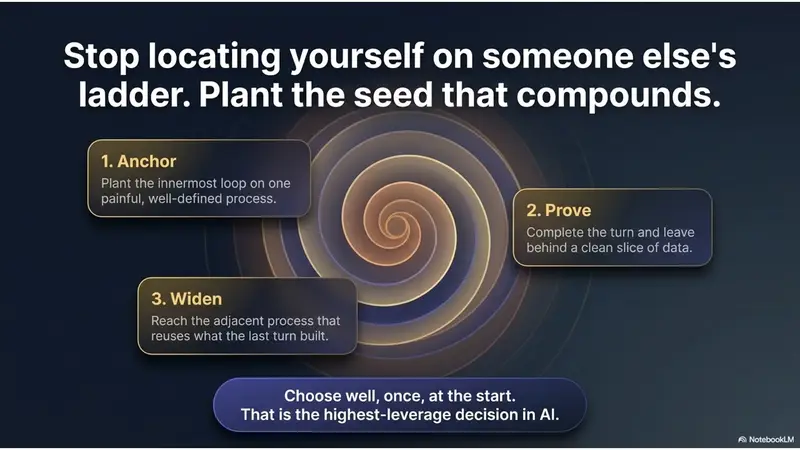
Stop trying to locate yourself on someone else's ladder. The question "which stage am I on?" has no useful answer, because there is no shared staircase. There is your data at the center, and the question of which loop to draw around it next.
Plant the innermost loop on one painful, well-defined process. Prove it. Let it leave behind a clean slice of data the next loop can stand on. Then widen the radius — and keep widening, one anchored turn at a time, reusing what each turn built. Maturity will follow on its own, and you'll be able to read it off afterward. You will never have to ask which rung you're on.
The two things the spiral needs are the two things that are hardest to buy off a shelf: someone to choose the seed that compounds, and the discipline to sequence rather than scatter. That choice — which loop to plant first, and whether the three AI tools you may already own can be pulled back onto one center — is the highest-leverage decision you'll make in this whole effort. If you'd rather not make it alone, that's exactly where an AI consulting engagement starts: we help you pick the seed that compounds and sequence the spiral around the data you already have. We don't run it for you. We help you choose well, once, at the start — where choosing well matters most.