
Vibe Coding for Software Teams
AI across your software team's process, from requirements to customer feedback, set up on one real feature.
AI can now build a small working app from one prompt. A real product needs AI built into how the team works at every step: requirements, design, code, tests, release, support and reading what customers say. Vibe coding means describing what you want and letting AI write the code. Vibe coding for software teams, sometimes called AI engineering enablement, adds the process around it. We set that process up with your team, run it on one real feature, and then support it.
It is for two kinds of company: one with its own IT team, and a development company that builds software for clients. Your developers stay in charge of the code and merge every change. If you want AI used well by all your staff, outside the software team, start with our AI consulting assessment.
Two risks once your whole team uses AI
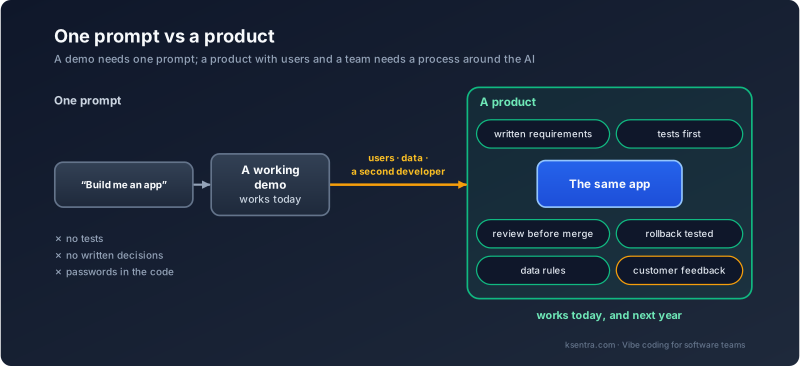
Wrong output that nobody catches. AI writes plausible code — and it can just as easily write a wrong requirement, or a test that passes even though the code is wrong. An agent can also be steered by instructions hidden in a ticket, log or customer message it reads. In the process we set up, the written requirements and their acceptance criteria (the conditions the result must meet) come first, the tests are written and reviewed before the code, the AI gets only the access a task needs, and a person approves every change before it goes in, so an instruction hidden in what it reads cannot push a change through on its own.
Code, passwords and data leaving the company. What an AI tool reads may be stored or used under its vendor's terms, which we check for each tool. We decide with you where each kind of code and data may go, keep passwords and keys out of what the AI reads, and mask customer data in test data, logs and tickets before an AI reads them. The full list of risks, including what an AI agent may install or run, is in the rules we write with you.
From requirements to what customers say
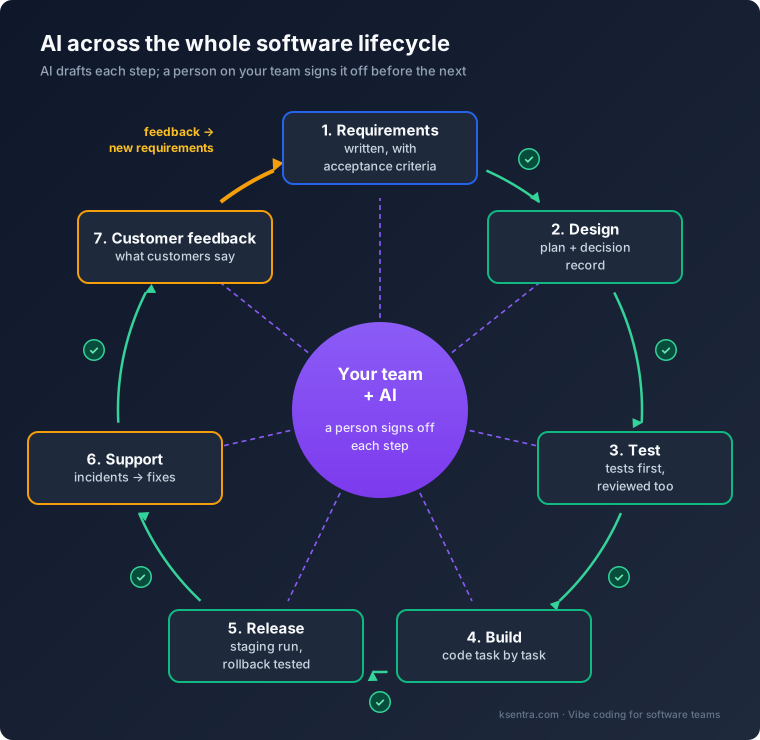
In each of the seven stages below, AI drafts and a named person owns the decision.
| Stage | What AI does | What a person owns | The check |
|---|---|---|---|
| 1. Requirements | AI drafts written requirements and acceptance criteria from interviews, tickets and notes | The analyst or product manager decides what is built | The requirements are signed off before any code |
| 2. Design | AI proposes the design and the task breakdown | The lead accepts or changes it | The decision is written down with its reason |
| 3. Test | Before the code, AI writes tests from the acceptance criteria; it reruns the full set on every change | QA decides what "done" means | Tests are reviewed before the code is written; any change to an existing test needs a person's approval |
| 4. Build | AI writes code task by task, after the tests for that task exist | A developer reviews and merges every change | Tests pass; review before merge |
| 5. Release | AI drafts release notes, deploy steps and the rollback | A person runs the release | Staging run first; rollback tested before release |
| 6. Support | AI sorts bug reports, reads logs, drafts fixes | Support or DevOps owns the incident | The fix starts with a test that reproduces the bug, then goes back through test, build and release |
| 7. Customer feedback | AI reads tickets, chats and reviews; groups complaints and requests | The product manager decides what goes into the backlog | Every finding cites the tickets or chats behind it |
What customers say becomes the next set of requirements, and the loop starts again.
The evidence explains why the checks matter. DORA's 2025 survey of about 5,000 technology professionals found that teams using more AI tend to ship changes faster — and to have less stable releases. Teams with automated tests, a disciplined history of every code change and quick feedback on each change benefit; without those controls, more change brings more breakage (DORA 2025 report).
Where your code may go
There are four places your team's code and data may go, and a company often needs more than one: a foreign cloud service; a cloud service in your own jurisdiction; an open tool with a model hosted in your jurisdiction; or your own server. In the sizing spec we work out with you where each kind of code and data may go, including your clients' code under NDA. You buy the tools from their vendors or from our partners.
What it costs to run
Seat plans make the bill predictable up to a usage limit; above it you either wait for the allowance to refresh or pay for extra usage. Pay-as-you-go plans bill by usage, mostly by how much code the AI reads for each task (seat and usage terms: vendor pricing pages, October 2026). Running models on your own server costs more per developer unless the team is large, and the open models you can run there usually trail the best cloud models — it is the route when code may not leave the company.
Three things drive the monthly bill: the pricing model, where your code may go, and how heavily each role uses AI (in our estimate, developers most, then QA, then analysts and project managers). For an AI coding agent, one vendor puts the average cost at about $150–250 per developer per month in large companies; heavy agent users spend more (October 2026). The larger cost is not on the tool bill: it is your people's time to review what the AI produces.
| You pay Ksentra | You pay vendors or our partners |
|---|---|
| The sizing spec, the pilot, monthly support | Seats or usage for the AI tools; servers, if you host models yourself |
Three ways to set up the tools for a team:
- Minimal: one team (two or three developers plus an analyst or QA) on one repository, with approved tools and the written rules.
- Optimal: the whole product team by role, with a monthly note on cost and quality.
- Closed setup, for code that may not leave the company or the country: your own server, or a setup hosted in your jurisdiction. It is quoted in the sizing spec and priced separately from the pilot.
We build the cost estimate from your team's own figures, not from ours.
How We Work
-
1
Sizing spec
After a free 30-minute call: a written document on how your team uses AI today, where code and data may go, tools by role with monthly costs, and the pilot plan.
-
2
Pilot
2–3 weeksWe set up the process with one team and take one real feature through the seven stages; customer feedback is read where the feature already has users. Your developers, working with the AI, write and merge the code.
-
3
Support
MonthlyA monthly note on what ran, what it cost, what broke and what customers said; rule and tool updates; coaching for new team members.
What stays with you: the repository and its history, the rules, the process documents, the tests and the tool accounts, all in your name.
What we don't do: resell tools or licences; work around a vendor's restrictions on which countries it serves; promise a speed or cost multiple; give legal clearance; run courses for individuals; build your product for you.
Price
Sizing spec
$1,500
paid upfront; counts toward the pilot
- How your team uses AI today
- Where each kind of code and data may go
- Tools by role, minimal and optimal monthly cost
- The pilot plan with its start date
Pilot
from $6,000
in total, the $1,500 sizing spec included; half of the total at the start (the spec counts toward it), half at acceptance
- Rules for code and data in force before the first task
- The process set up with one team
- One real feature through the seven stages; customer feedback is read where the feature already has users
- Accepted once the process has run end to end, or on the process alone if the feature hasn't shipped by week four; speed is reported, not promised
Support
from $1,200 / mo
after the pilot
- A monthly note: what ran, what it cost, what broke, what customers said
- Rule and tool updates; a tool or model switch is a separate small project
- Review of AI-related incidents
- Coaching for new team members
Every engagement starts with the sizing spec. We run one pilot at a time; the sizing spec sets the pilot's start date, normally within four weeks of its delivery; if our next free slot is later, the spec's credit stays open for three months.
How we build our own products
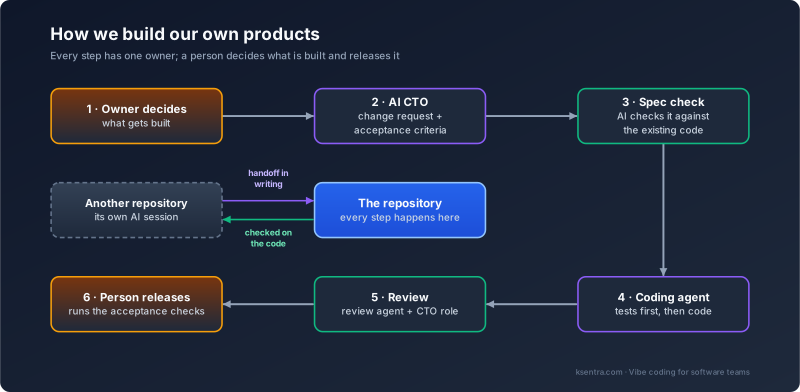
We run this process as one developer working with AI agents, on one foreign cloud coding tool.
On our own software, each new feature starts as a change request with acceptance criteria, written by an AI agent in the CTO role; a person decides what is built and rules on the open questions in it. Before building, another AI checks the request against the existing code. A coding agent writes the tests first, then the code. A review agent and the CTO role check it, and a person releases it and runs the acceptance checks. In your team, a developer's review before merge replaces our review agent as the main check; the agent becomes the second one. Our chatbot platform and our insurance sales bot were built this way, across separate repositories that hand work to each other in writing.
PolisBot, our insurance sales bot
Built with this process for the Russian market, on our existing chatbot platform. First commit: 24 September 2026. First real purchase, end to end: 16 October 2026, a policy we bought ourselves with real money.
Our chatbot platform
More than 40 change requests with written acceptance criteria since February 2026, 39 of them shipped; test-first since April 2026. As of October 2026 it serves seven live sites and runs more than 5,700 automated tests. During a planned move to a new host, the old server failed on 11 October 2026; all five applications it hosted were restored on the new host from backups the same day.
If you run a development company
The process works role by role, and your people keep every decision:
- Developers: the AI writes code task by task from the requirements, test-first; your developers review and merge every change.
- QA: the AI generates tests from the acceptance criteria; your QA reviews them like code.
- Analysts and product managers: the AI turns interviews and tickets into requirements and groups customer feedback; the analyst signs off.
- Project managers: the AI drafts status and release notes from the work itself.
- Support and DevOps: the AI sorts bug reports, reads logs and drafts fixes, which go back through the process.
The rules we write with you sort your clients' code by sensitivity, so code under NDA goes only where that client allows. The practices we bring are change requests with acceptance criteria, a review of each request against the existing code before any coding starts, and test-first development. You roll the process out team by team, starting with the pilot team.
This page is about AI inside your software team. If you need AI that does a business task, such as answering customers or running a workflow, see our AI agents service.
Frequently Asked Questions
Is this for us?
Yes, if you have your own IT team or run a development company and your people already use AI, or want to. It is not for individuals learning vibe coding (we run no courses), and not for integrators looking for a subcontractor. If you want AI used well by all your staff, outside the software team, start with our AI consulting assessment.
Our head of IT says we already do this.
Your team keeps its tools. We add what is usually missing: the process from requirements to customer feedback, the rules for where code and data may go, and a view of what it all costs each month. The sizing spec shows which of these you already have.
What do you need from us?
Access to one repository, one real feature to take through the process, time from the team that will run it, and your current policy on who may access code and data.
How long does it take, and when can you start?
The pilot takes 2–3 weeks with one team. We run one pilot at a time; the sizing spec sets the pilot's start date, normally within four weeks of its delivery; if our next free slot is later, the spec's credit stays open for three months. If your team hasn't shipped the feature by the end of the pilot's fourth week, we accept the pilot on the process alone: requirements, design, build and tests ran and were checked, and the release and rollback steps are written and dry-run.
What does it cost, and will it pay off?
The sizing spec is $1,500. The pilot is from $6,000 in total, with the $1,500 spec included, so you pay from $4,500 more after the spec; of the total, half is due at the start, the spec counting toward it, and half at acceptance. Support is from $1,200 a month. You pay the vendors or our partners for the tools and any servers. We build the payback estimate from your team's own costs and report speed after the pilot instead of promising it. In METR's 2025 randomized trial, 16 experienced open-source developers took 19% longer on tasks with AI while believing they were 20% faster. METR's 2026 follow-up says developers are likely faster with AI now than in early 2025, but calls its own data only very weak evidence of how much faster.
Is our code safe, and who owns it?
We don't promise that any setup is safe or legally cleared; we put written rules for where code and data may go in force before the first task. The code stays in your repository and the tool accounts are in your name. The rules cover licence and ownership questions for AI-written code. The sizing spec names who on our side accesses your repository and which of your tools we can work in under their vendors' terms.
What if we stop?
Everything stays with you: the repository and its history, the rules, the process documents, the tests and the accounts.
Which tools do you use, and how is this different from your AI consulting assessment?
We choose tools to fit your requirements, from their vendors or our partners. Our AI consulting assessment builds the AI roadmap for the whole company. This service puts AI inside your software team's process.
Want AI built into how your team ships software?
Tell us about your team and your product, and we will show where your current process needs checks and what a sizing spec would cover.