GLM vs Claude for Coding: Three Ways to Use GLM and What Each Costs
Updated: 22 November 2026
GLM vs Claude? For writing code, Claude is well ahead. On Terminal-Bench 4.1, an independent coding test, Claude's best models solve about 66 tasks in 100. GLM-5.3, Z.ai's top open model, solves about 41, where Claude was by early June.
GLM's real advantage is what Claude can't offer: you can run it on your own servers, so code and data go to no outside AI service. Its weights are free to download, but the GPUs to run it for your team cost more than Claude's plan for one person and a team of 10, and at about 200 people, on the smaller GLM-5.3-Flash, at best about what Claude Enterprise costs.
Model names used here:
- GLM: Z.ai's family of AI models, several published as open weights, that is, files you can download and run on your own servers. Z.ai is the company that makes GLM. GLM-5.3: Z.ai's largest open model; GLM-5.3-Flash: its smaller one.
- Claude Opus 5.5, Sonnet 5.5 and Haiku 5.5: Anthropic's large, middle and small models; Fable is another Claude model family.
Contents
- Three ways to use GLM, side by side
- How far behind is GLM at writing code?
- GLM in the cloud: Z.ai's Coding Plan and API
- What each GLM and Claude route costs at three team sizes
- Chatbots and AI agents on GLM or Claude
- What running GLM yourself buys, and what it costs beyond the GPUs
- How to choose between GLM and Claude: a test on your own tasks
- GLM vs Claude FAQ
- What changed on GLM vs Claude since this page was first published
Three ways to use GLM, side by side
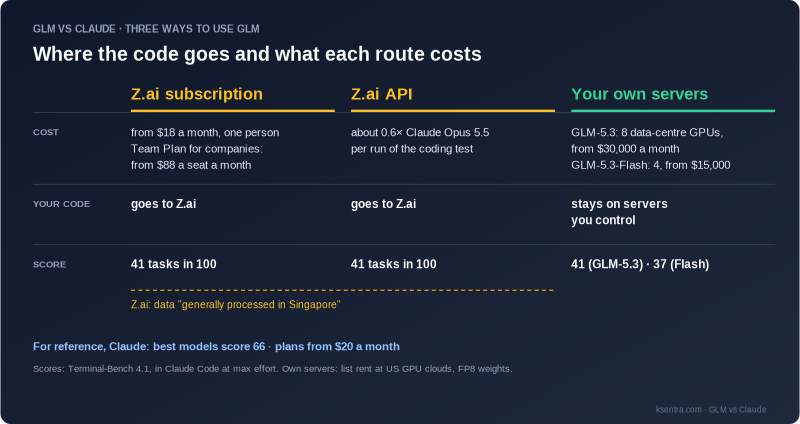
You can use GLM in three ways: Z.ai's subscription, Z.ai's API (pay per use), or on servers you control. Each costs a different amount and sends your code to a different place.
| Route | Score per 100 (Terminal-Bench 4.1) | Where the code goes | Per developer-equivalent a month: one person | Team of 10 | About 200 people |
|---|---|---|---|---|---|
| Claude plan for that size (Pro to Ultra · Team · Enterprise) | 64–66 | Anthropic, a US company | $20–200 | $30–152 | $177–277 |
| Claude Opus 5.5 / Sonnet 5.5, pay as you go | 65.76 / 63.94 | Anthropic | $150–250 / $175–389 | the same | the same |
| GLM Coding Plan: individual plan for one person, Team Plan for a company | 41.21 | Z.ai | $18–168 | $107–228 | $119–255 |
| GLM-5.3, Z.ai API | 41.21 | Z.ai | $87–159 | $87–159 | $87–159 |
| GLM-5.3 on your own GPUs | 41.21 | servers you control | $30,470–34,982 | $3,693–4,240 | $913–1,839 |
| GLM-5.3-Flash on your own GPUs | 36.97 | servers you control | $15,235–17,491 | $1,847–2,120 | $152–368 |
Our arithmetic on list prices before tax; sizes are examples. A developer-equivalent counts a developer as 1, a tester as half and anyone else as a quarter (our weights). Claude Enterprise: $20 a seat plus usage at Anthropic's average (our assumption). Own GPUs: rent at US GPU clouds, Z.ai's FP8 weights, every user's long session held in GPU memory; bought hardware not modelled. How each cell is counted.
- If the code may not leave the company, only servers you control remain, bought or at a host your rules accept: at best from $913 per developer-equivalent a month at about 200 people on GLM-5.3 ($609 with a 4-bit build), or $152 on GLM-5.3-Flash, at rent. On a rented server the code sits with that host.
- If the code may go to a cloud and a lower score is acceptable (41 against 64–66 tasks in 100), test Z.ai's Team Plan (two seats minimum, from $176 a month) or its API against Claude Opus or Sonnet on your own tasks.
How far behind is GLM at writing code?
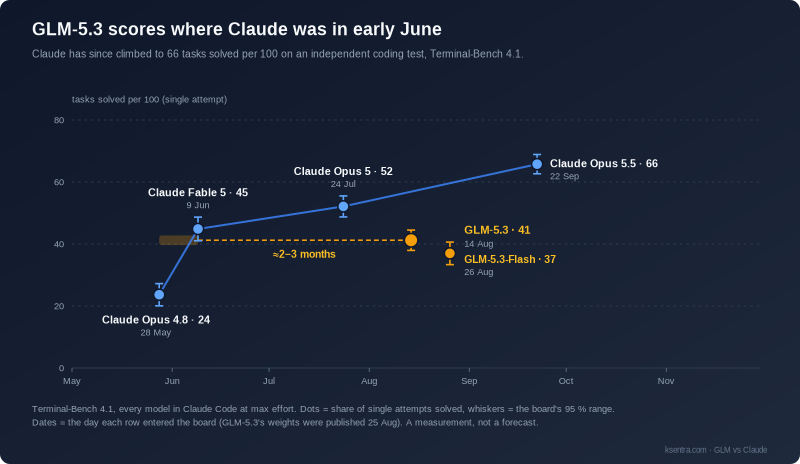
On code, GLM-5.3 scores where Claude's best models were two to three months before it came out, and Claude has kept climbing.
Terminal-Bench 4.1 gives an AI agent real tasks in a terminal, the text window developers type commands into, and checks whether each one is done. Each row of the leaderboard gets 330 attempts, so "41 in 100" is the share of single attempts that pass. Every row below ran in Claude Code, Anthropic's coding tool, at "max" effort, each vendor's top setting for how long the model thinks.
| Model, in Claude Code at "max" effort | Tasks solved per 100 (the leaderboard's 95 % range) | Date |
|---|---|---|
| Claude Opus 5.5 | 65.76 (62.7–68.9) | on the board from 22 September 2026 |
| Claude Sonnet 5.5 | 63.94 (60.9–66.9) | on the board from 28 September 2026 |
| Claude Fable 5 | 44.85 (41.0–48.7) | on the board from 9 June 2026 |
| GLM-5.3, through Z.ai | 41.21 (37.9–44.5) | on the board from 14 August; weights published 25 August 2026 |
| GLM-5.3-Flash | 36.97 (33.3–40.6) | on the board from 26 August 2026 |
| Claude Opus 4.8 | 23.64 (20.1–27.2) | published 28 May 2026 |
GLM-5.3 scores clearly above Opus 4.8. Fable 5, nine weeks older, is the first Claude row the test can't tell apart from it: the ranges overlap. Since then Claude's best has gone from 44.85 to 65.76. Claude's smallest model, Haiku 5.5, scores 40.00.
What Terminal-Bench 4.1 doesn't show
- The tool. Every row ran in Claude Code, where Z.ai tests GLM-5.3 itself; there is no GLM row in ZCode or OpenCode.
- Other open models. GLM-5.3 is the highest-scoring open model that fits one 8-GPU H200 or B200 server (Nvidia data-centre GPUs). Kimi K3.1 Pro scores higher (59.70), but its weights need more than one such server. Open models compared with Claude.
- Z.ai's own table compares GLM-5.3 with older Claude models, Opus 4.8 and Fable 5.
- Other work. No independent test we read covers GLM on writing, analysis or chat.
What each solved task costs at each host is in our guide to coding tools; OpenAI's tool is in the Codex comparison.
GLM in the cloud: Z.ai's Coding Plan and API
GLM Coding Plan: the individual plan and the Team Plan
The GLM Coding Plan is Z.ai's monthly subscription for GLM-5.3 and GLM-5.3-Flash in coding tools such as Claude Code, OpenCode and ZCode (how it plugs into Claude Code). Usage is counted in credits, Z.ai's unit, capped per 5 hours and per week.
| Plan (monthly billing) | Price | Credits per 5 hours / per week | GLM-5.3 tokens a month (Z.ai's weekly estimate × 4.33) | Against an average developer's month of 276–505 million GLM-5.3 tokens (our arithmetic) |
|---|---|---|---|---|
| Lite, one person | $18 | 2,000 / 10,000 | 217–429 million | 0.4–1.6× |
| Pro, one person | $80 | 12,000 / 60,000 | 1,287–2,578 million | 2.6–9.3× |
| Max, one person | $168 | 28,000 / 140,000 | 3,007–6,010 million | 6.0–21.8× |
| Team Plan, Standard seat | $88 a seat | 15,000 / 66,000 | — | about Pro's volume |
| Team Plan, Premium seat | $188 a seat | 35,000 / 155,000 | — | about Max's volume |
Prices: Z.ai's subscription page; yearly billing is 30 % off individual plans and 10 % off Team seats. Tokens: Z.ai's plan overview, 96 % of input from the cache, from all-peak to all-off-peak use; outside peak hours (Monday–Friday 14:00–18:00 Singapore time) usage costs half the credits.
The Coding Plan table's last column: Anthropic's average Claude Code spend, $150–250 per developer a month across enterprise deployments, buys about 255–467 million tokens at Opus 5.5's prices and mix on the test; GLM-5.3 needs 1.08 times as many, about 276–505 million. Lite covers 0.4 of that month for a $250 developer in peak hours and 1.6 for a $150 developer off-peak.
The individual plan is for one person. Z.ai's subscription terms license it "only to the individual natural person associated with such account" and bar "your colleagues, friends, customers or any organization" from its quota. For companies, Z.ai sells the Team Plan, "a self-service subscription for enterprises and teams": at least two seats, one person per seat. Z.ai says that on it "Data is not used for model training by default".
For 10 people the Team Plan costs $880–1,880 a month, Standard to Premium; Claude Team costs $250–1,250 ($25–125 a seat), with usage limits Anthropic doesn't publish as tokens. The two vendors' seats buy different amounts of work, so compare them on your own tasks. Z.ai's subscriptions are non-refundable.
Z.ai API, pay as you go
The GLM API from Z.ai bills per token: GLM-5.3 $1.40 per million input tokens, $0.26 for input read from the cache and $4.40 per million output tokens; GLM-5.3-Flash $0.15, $0.03 and $0.50 (Z.ai's pricing). Claude Opus 5.5 lists $4, $0.20 and $20 per million for the same three.
A price per token says little, because models spend different amounts on the same task. A full run of Terminal-Bench 4.1 cost GLM-5.3 $2,728: 0.58–0.63 times Opus 5.5's $4,299–4,719, and less than Sonnet 5.5's $5,016–7,334. It solved 0.63 times as many tasks as Opus, so per solved task it costs about the same as Opus and less than Sonnet (by host).
Where your code goes with Z.ai and with Claude
- Z.ai, on the subscription and the API: the service is run by a Singapore company, and Z.ai's privacy policy says "Customer Data is generally processed in Singapore". For the API, its terms say your content isn't used to develop or improve the service "unless you explicitly agree". For individual users, Z.ai reserves "the right to process any User Content to improve our existing Services and/or to develop new products and services"; we read that clause as covering the individual Coding Plan. The Team Plan excludes training by default.
- Claude: code goes to Anthropic, a US company.
- What we didn't check: who owns Z.ai, or which countries' laws reach it. Ask Z.ai, and check with your own security team, before you send code.
Your own data rules decide which of these is allowed.
What each GLM and Claude route costs at three team sizes
On Terminal-Bench 4.1, GLM-5.3 solves 41 tasks in 100 and Flash 37, against Claude's 64–66. Your own GPUs cost far more than any cloud route for one person and a team of 10; at about 200 people, GLM-5.3-Flash costs at best about what Claude Enterprise does, and GLM-5.3 about three to ten times as much ($913–1,839 against $177–277 per developer-equivalent a month).
Monthly totals, our arithmetic on list prices before tax; sizes are examples. Own GPUs: rent only, at Z.ai's published 8-bit (FP8) weights. 4-bit builds take about 0.6 times the memory; the ones the guides name for Nvidia use its newest (Blackwell) format, so we price them on B200s: GLM-5.3 then costs $609–1,471 per developer-equivalent at about 200 people.
| Route | Score per 100 (Terminal-Bench 4.1) | One person, total a month | Team of 10, total a month (8.25 developer-equivalents) | About 200 people, total a month (147.5) |
|---|---|---|---|---|
| Claude Opus 5.5, pay as you go | 65.76 | $150–250 | $1,238–2,062 | $22,125–36,875 |
| Claude Sonnet 5.5, pay as you go | 63.94 | $175–389 | $1,444–3,205 | $25,816–57,310 |
| Claude seats (usage limits apply) | by the model used | $20–200 (Pro to Ultra) | $250–1,250 (Team) | $26,125–40,875 (Enterprise, $20 a seat plus usage at Anthropic's average, our assumption) |
| GLM Coding Plan | 41.21 | $18–168 (individual, Lite to Max) | $880–1,880 (Team Plan) | $17,600–37,600 (Team Plan) |
| GLM-5.3, Z.ai API | 41.21 | $87–159 | $715–1,309 | $12,789–23,399 |
| GLM-5.3 on your own GPUs, rent only | 41.21 | $30,470–34,982 (one 8×H200 server) | $30,470–34,982 (one 8×H200) | $134,729–271,268 (3–5 servers of 8×B200) |
| GLM-5.3-Flash on your own GPUs, rent only | 36.97 | $15,235–17,491 (one 4×H200 server) | $15,235–17,491 (one 4×H200) | $22,455–54,254 (one 4×B200 to one 8×B200) |
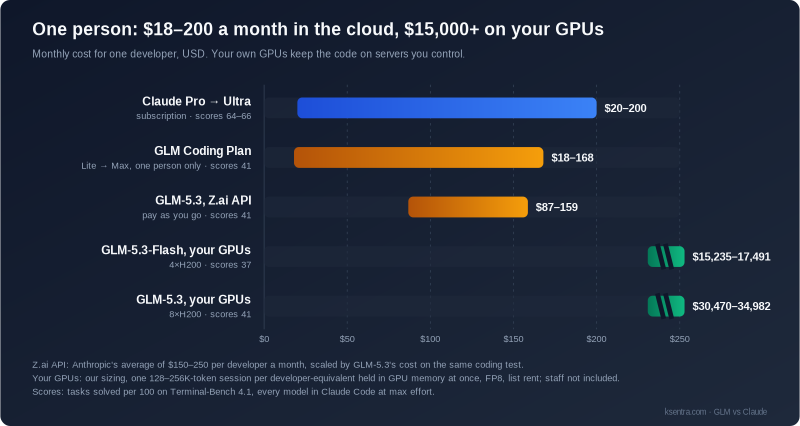
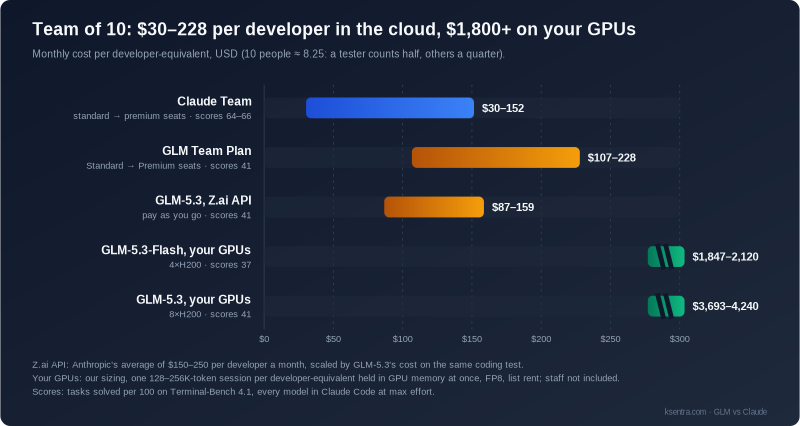
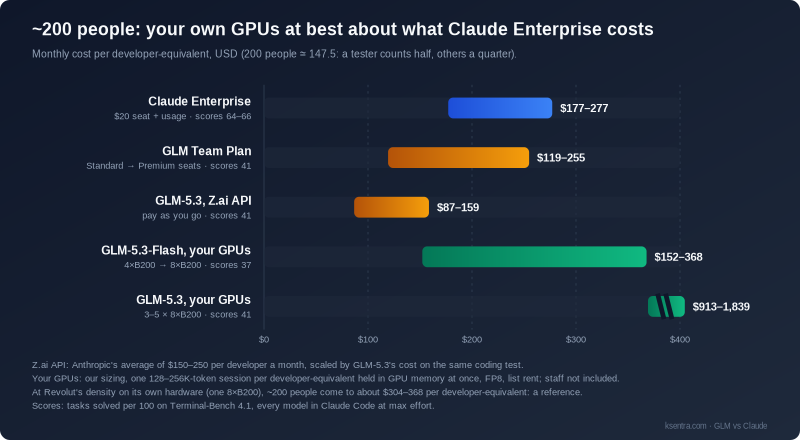
How we counted the GLM and Claude costs
- Sizes (examples): 10 = 7 developers, 2 testers, 1 other; about 200 = 120 developers, 30 testers, 50 others, weighted 1, 0.5 and 0.25 (our estimate), which also sets the sessions on your own GPUs.
- Pay as you go: Anthropic says Claude Code averages $150–250 per developer a month across enterprise deployments (Claude Code plans for business). We take that as Opus 5.5's level and scale the other rows by each model's cost on the same test, at list price and at the test's own bill.
- Seats: Claude's and Z.ai's pricing pages, monthly billing, one seat per person.
- GPUs, sized by memory: one session of 128–256 thousand tokens per developer-equivalent held in GPU memory at once: about 7–14 GB for GLM-5.3 (54 KB per token at 8-bit, our arithmetic from its configuration file), 2–3 GB for Flash. We assume the GPUs split users between them, 90 % of memory usable, 6 GB per GPU for the software: the best case. With vLLM's default setup, about a tenth as many fit on GLM-5.3.
- Precision: FP8 and 4-bit say how precisely the model's numbers are stored; fewer bits, less memory, possibly lower quality. GLM-5.3's FP8 weights take about 755 GB, Flash's 328 GB. On H200s Flash keeps session memory at 16-bit by default, so its cheapest 200-person setup is on B200s.
- Rent: H200 $5.29 (RunPod) to $5.99 (Together AI) per GPU-hour; B200 $7.69 (Lambda) to $9.29 (Together AI). Hours a month: H200 720 at the low price and 730 at the high one, B200 730.
Not measured:
- how many people work at once or run tasks in parallel;
- speed under load (memory isn't speed);
- the quality cost of 8-bit session memory or 4-bit weights;
- the extra memory when answers are sped up with a draft model (about 1 %);
- bought or reserved hardware;
- your staff time.
One company's numbers: Revolut
In an October 2026 talk, Revolut said it serves GLM-5.3 to roughly 2,000 engineers on 56 B200 GPUs, at 4-bit ("FP4") with sessions of about 256 thousand tokens. Before, it saw "engineers spend a thousand a month, 10,000 a month with not so much ROI". Now "our invoice is one-tenth of what we were spending on Anthropic and OpenAI", with Claude Code and Codex kept "as exception". The talk names OpenCode and Codex as the tools its engineers use GLM in; the test above ran in Claude Code.
At list rent, its 56 GPUs cost about $157–190 per engineer a month, about Claude Enterprise's $177–277 per developer-equivalent. The talk doesn't say whether the GPUs are owned or how many engineers work at once; its page calls the figures "not a portable price for any self-hosted model".
By our sizing, one of Revolut's 8×B200 servers at 4-bit holds 47 long sessions; Revolut serves about 286 engineers per server, six per session. At that density our 200-person example fits one 8×B200 server, $304–368 per developer-equivalent: a reference, not a forecast; a load test on your own work sets the number.
Pros and cons of each GLM and Claude route
| Route | Good for | Watch for |
|---|---|---|
| Claude Opus and Sonnet | the highest scores here: Opus for planning and specs, Sonnet for most of the coding | the bill grows with use; code goes to Anthropic |
| Claude seats | Pro, Ultra and Team: a flat seat price up to a usage limit | usage limits apply; Enterprise adds usage to its $20 seat |
| GLM Coding Plan / Team Plan | a flat monthly price; the Team Plan excludes training by default | 41 against 64–66 tasks in 100 on Terminal-Bench 4.1; individual plans are personal-use only; non-refundable; code goes to Z.ai |
| GLM-5.3, Z.ai API | per run, 0.58–0.63 times Opus 5.5's cost | about the same per solved task as Opus; code goes to Z.ai |
| GLM-5.3 on your own GPUs | code stays on servers you control; no per-token bill | at FP8, from one 8×H200 server, $30,470 a month at rent; above every Claude plan at the sizes we modelled; staff and tuning |
| GLM-5.3-Flash on your own GPUs | the same control on fewer GPUs; MIT licence | scores 37; at about 200 people at best about Claude Enterprise's cost, before staff |
Chatbots and AI agents on GLM or Claude
A chatbot's tokens are a small bill on a small model. For 21,000 agent tasks a month, GLM-5.3 costs $759–1,659 in tokens, against $1,104–2,604 on Sonnet and $59–180 on Haiku or Flash.
| Model, tokens only (our arithmetic on list prices) | Per 1,000 chats | 100,000 chats a month | Per agent task, nothing cached | 21,000 agent tasks a month, 0–80 % cached |
|---|---|---|---|---|
| Claude Haiku 5.5 | $0.49 | $49 | $0.0062 | $59–130 |
| Claude Sonnet 5.5 | $9.81 | $981 | $0.124 | $1,104–2,604 |
| GLM-5.3-Flash, Z.ai | $0.68 | $68 | $0.0086 | $85–180 |
| GLM-5.3, Z.ai | $6.26 | $626 | $0.079 | $759–1,659 |
Chats: about 4,000 tokens each, the average across 83 chats on our own bots (July–October 2026). Agent tasks: 50,000 tokens each (our assumption). With reasoning turned down: at its top reasoning setting GLM-5.3-Flash wrote about three times as many output tokens on the coding test. Setup, hosting and our fees excluded.
Which model fits depends on answers from your documents, which no independent test we read measures. Our cloud platform service and private platform service run that test on your own questions before the model is chosen. Our bots and agents answer people who write in; we don't build outbound calling or voice agents.
Want your bots and agents on a layer that fits your data?
Tell us what you run or plan to run, and we will show which option fits your data.
What running GLM yourself buys, and what it costs beyond the GPUs
Running GLM on servers you control, your own or a host you choose, buys this: code and documents go to no outside AI service, your security team can assess the setup, there is no per-token bill, and you decide when the model changes. It costs more than the GPUs:
- Hardware or rent. At Z.ai's FP8 weights, GLM-5.3 needs eight H200-class GPUs and GLM-5.3-Flash four; 4-bit builds take about 0.6 times the memory, quality unconfirmed by any independent test we read. One person's server, by the month.
- Staff and tuning. Someone runs the servers and watches speed: Revolut's tuning cut the wait until an answer starts from 14 seconds to under 2.
- Quality. On Terminal-Bench 4.1, GLM-5.3 solves about 41 tasks in 100 and Flash about 37, against 64–66 for Claude's best models.
- A one-GPU route. A smaller open model can run on one 80 GB GPU; it has no score on the independent test (Qwen vs Claude).
- Our work, if you hire us for it. On our private platform page, the sizing spec is $1,500 and counts toward the setup, which is from $10,000; remote support is from $1,000 a month. These are our fees; servers are rented or bought and paid for separately, and hardware beyond our price table is quoted in the spec. What our private deployment costs and how we size it.
- Which of our services does what. For a coding team, our vibe coding service sets up the coding process and the closed setup; our private platform service sizes and runs the servers. At eight-GPU sizes, setup and support are quoted in the sizing spec, above these starting prices.
GLM licences, in plain words
- GLM-5.3 has its own licence. A company whose group sells access to AI models (a "model as a service" business) and has more than $10 billion in total revenue a year must pass Z.ai's security review before any commercial use, inside the company too. Any other company needs nothing extra, beyond keeping the licence notice if it passes the model on.
- GLM-5.3-Flash is MIT: commercial use allowed; keep the licence notice if you pass it on.
Our private platform works with open models whose licences allow commercial use; which model fits your work is decided in the sizing spec. If you choose GLM-5.3, you hold its licence. For code that may not leave, our vibe coding service sets up a closed setup on your own server or a host in your jurisdiction.
How to choose between GLM and Claude: a test on your own tasks
For code that may not leave, start with the closed setup above. Otherwise, the conditions:
- The code may go to a cloud, and the budget matters. Put Z.ai's Team Plan or its API next to Claude Opus or Sonnet on your own tasks.
- The code may not leave. Your own servers: what they buy and cost.
- A large team weighing its own servers. Read Revolut's numbers, then run a load test against a pass criterion written before the pilot starts, as on our private platform page.
- Some code may leave and some may not. Route each kind of task by what your own test shows.
Your test: run the same 20–30 real tasks (bug fixes, small features, reviews) through two or three candidates and count what passes without rework:
| Task | Passed without rework? | Minutes to fix |
|---|---|---|
Our vibe coding service decides with you where each kind of code may go and runs a process pilot.
GLM vs Claude FAQ
What is GLM and who makes it?
GLM is a family of AI models from Z.ai. Several, including GLM-5.3 and GLM-5.3-Flash, are published as open weights you can download and run; Z.ai also sells them through its API and the GLM Coding Plan.
Is GLM better than Claude?
For code, no. On Terminal-Bench 4.1, in Claude Code at "max" effort, GLM-5.3 solves about 41 tasks in 100 and Claude's best models about 66. GLM-5.3 scores where Claude was in early June.
Is GLM cheaper than Claude?
It depends on the route, and on every route GLM solves fewer tasks: about 41 in 100 on Terminal-Bench 4.1, against 64–66. Z.ai's Team Plan seats cost $88–188 a month and Claude Team's $25–125, for different amounts of work. Through the API, GLM-5.3 costs about 0.6 times Opus 5.5 per test run for about 0.6 times the solved tasks. On your own servers, GLM-5.3 costs more than Claude's plan at every size we modelled; GLM-5.3-Flash at about 200 people at best about Claude Enterprise ($152–368 against $177–277 per developer-equivalent a month). Revolut reports a bill a tenth of its Anthropic and OpenAI spend; at list rent its GPUs come to about Claude Enterprise's level.
GLM-5.3 or GLM-5.3-Flash?
On Terminal-Bench 4.1, GLM-5.3 solves 41 tasks in 100 and Flash 37; a test run cost Flash about a seventh of GLM-5.3's ($375 against $2,728). At Z.ai's FP8 weights, GLM-5.3 needs eight H200-class GPUs and Flash four. GLM-5.3 has its own licence; Flash is MIT.
What is the GLM Coding Plan and does it work in Claude Code?
It is Z.ai's monthly subscription for GLM in coding tools, Claude Code included: $18–168 a month for one person (not to be shared with colleagues), or Team Plan seats at $88–188 for a company. On Terminal-Bench 4.1, GLM-5.3 solves about 41 tasks in 100 against Claude's 64–66.
Where does our code go if we use GLM?
Through Z.ai's subscription or API, to Z.ai, whose policy says data is "generally processed in Singapore". On your own servers, it stays on servers you control. With Claude, it goes to Anthropic, a US company.
Can we run GLM on our own servers?
Yes, GLM can run on your own servers. At Z.ai's FP8 weights, GLM-5.3 needs one server of eight H200-class GPUs, $30,470–34,982 a month at list rent, and GLM-5.3-Flash one of four, $15,235–17,491. Staff, setup and tuning come on top.
Is GLM free?
The open weights are free to download; the GPUs to run them aren't. Z.ai's Coding Plan and API are paid.
Can we use GLM commercially?
Yes, GLM can be used commercially. GLM-5.3-Flash is MIT. GLM-5.3 needs Z.ai's security review before commercial use only for a group that sells access to AI models and has more than $10 billion in total revenue a year; any other company needs nothing extra.
Which GLM route fits your jobs and size?
Start with a free 30-minute call: tell us what the model must do, how many people will use it and where your code may go, and we will show which routes to test on your own tasks.
What changed on GLM vs Claude since this page was first published
| Date | Change | What it means for you |
|---|---|---|
| 17 Nov | A new top row on Terminal-Bench 4.1: GitHub Copilot with Copilot Fusion, 71.21 | the gap here is measured against Claude's best models, not the top of the board |
| 9 Nov | Claude Code with Fable 5.2 ties Opus 5.5 at 65.76 | Claude's best score on the test is unchanged |
| 21 Apr | Z.ai's plan notice listed Pro at $72 and Max at $160; the subscription page now shows $80 and $168 | the table uses today's prices |
| since 25 Aug | No new GLM model on Z.ai's model page | the scores above are GLM's newest |
We re-read this page when Z.ai releases a new GLM or the test adds a GLM row.