
Qwen vs Claude: What Each Route Costs a Team and What It Scores
Updated: 21 November 2026
Qwen vs Claude? For writing code, Claude is far ahead. On Terminal-Bench 4.1, an independent coding test, Claude's best models solve about 66 tasks in 100. Qwen3.8-Max, the only Qwen model on that test, solves about 27, roughly where Claude was in late May. It costs less per run, or about the same, so the lower price doesn't make up for the work it leaves undone.
Qwen's real advantage is that you can run it on your own servers, so code and data stay inside the company. Its open model Qwen3.8-27B is free to download under the Apache-2.0 licence, but it has no score on the independent test; on Alibaba's own tests it reaches 75–91 % of Qwen3.8-Max. And renting the GPUs to run it for your whole team costs more than Claude's plan for one person and for a team of 10, and usually more at about 200 people (the cost per developer).
In short:
- Writing code. On the coding test, Claude's best models solve about 66 tasks in 100 and Qwen3.8-Max about 27, both in Claude Code, Anthropic's coding tool, at the leaderboard's "max" effort setting.
- Chatbots and agents. Choose by where the data may go. A chatbot's token bill is small on a small model at every size.
- Your own servers. They buy control over code and data; at hourly list GPU rents they cost more than Claude's plan for one person and a team of 10, and usually more at about 200 people. Our GPU counts make sure every user's task fits in memory; they say nothing about speed, which only a load test on your own work shows.
Model names used here:
- Qwen: Alibaba's family of AI models; Claude: Anthropic's.
- Qwen3.8-Max: Alibaba's hosted flagship, the one Qwen model with a score on the test.
- Qwen3.8-27B: a Qwen model you can run on one GPU, not on the test.
- Qwen4-Max: Alibaba's newest hosted model, not on the test yet.
- Claude Opus 5.5, Sonnet 5.5 and Haiku 5.5: Anthropic's large, middle and small models.
Contents
- Decision map: Qwen or Claude, by where your code and data may go
- Your own GPUs or Claude: the cost per developer
- How far behind is Qwen at writing code?
- What vibe coding costs at three team sizes
- Chatbots and AI agents: the cost on Claude, Qwen or your own servers
- What running a model yourself buys, and what it costs beyond the GPUs
- How to choose between Qwen and Claude: a test on your own tasks
- Qwen vs Claude FAQ
- What changed since this page was first published
Decision map: Qwen or Claude, by where your code and data may go
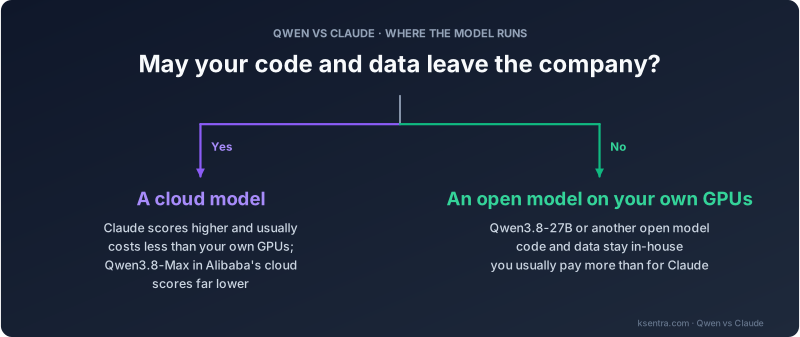
If your code and data may go to a cloud, Claude scores far higher than Qwen3.8-Max and usually costs less than your own GPUs. If they may not leave the company, you run an open model such as Qwen3.8-27B yourself and pay more than for Claude for one person and a team of 10, and usually more at about 200 people.
| Route | Score per 100 (Terminal-Bench 4.1) | Who runs the model | Coding cost a month: one person | Team of 10 | About 200 people | What you trade |
|---|---|---|---|---|---|---|
| Claude Opus 5.5, pay as you go | 65.76 | Anthropic | $150–250 | $1,238–2,062 | $22,125–36,875 | the top score here; the bill grows with use |
| Claude Sonnet 5.5, pay as you go | 63.94 | Anthropic | $175–389 | $1,444–3,205 | $25,816–57,310 | a near-top score; it spends more tokens per task than Opus, so on this test it costs more |
| Qwen3.8-Max, through Alibaba's cloud | 26.97 | Alibaba | $53–246 | $437–2,026 | $7,821–36,227 | the lowest score here; costs less than Sonnet, up to about what Opus costs |
| Qwen3.8-27B on your own GPUs | no score | you, on rented or bought GPUs | $2,081–2,873 rent to the GPU cloud (one H100) | $4,162–5,746 (two H100) | $33,682–74,599 (6–11 B200) | code and data stay in; staff, setup and tuning on top |
Our arithmetic on vendor list prices and GPU rents (H100: one US GPU cloud's list, 23 October; B200: two other GPU clouds' lists). Scores: every model in Claude Code at the leaderboard's "max" effort. The Claude rows are pay as you go, scaled from Anthropic's stated average; Claude's seat plans are compared in the cost per developer. Your own GPUs are sized so every user's open coding task, 128–256 thousand tokens, stays in GPU memory at once, one session per developer-equivalent; that is memory, not speed. The sizes are examples, so change them to yours; how each cell is counted is under the coding cost table. Qwen4-Max (16 November) has no score on this test yet; Alibaba lists it at $1.5 per million input tokens and $4.5 per million output tokens.
In the 200-person example, agents cost about $60–2,600 a month in tokens (chatbots and agents). That assumes 21,000 tasks a month of 50,000 tokens each; the range runs by model and by how much of the text is cached, that is, already read and billed at a lower rate.
Your own GPUs or Claude: the cost per developer
Per developer-equivalent a month (we count a tester as half a developer, and an analyst or manager as a quarter):
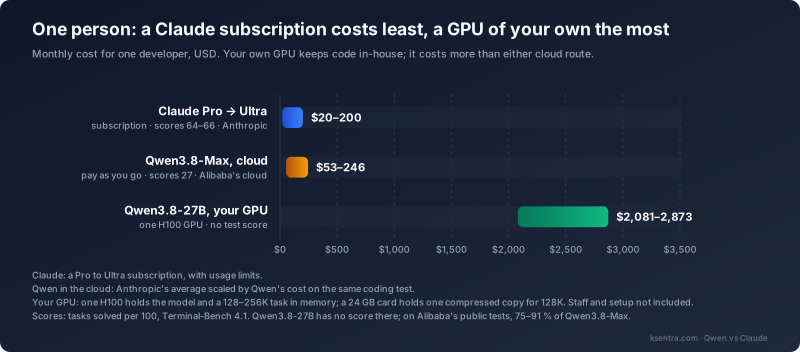
- one person: $2,081–2,873 for one H100 GPU, against $20–200 for a Claude subscription;
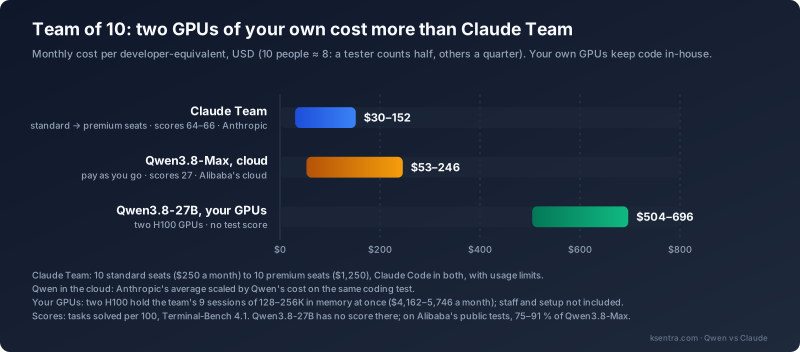
- a team of 10 (8.25 developer-equivalents): $504–696 each, from $4,162–5,746 for two H100 GPUs, against $30–152 on Claude Team ($250–1,250 for the team);
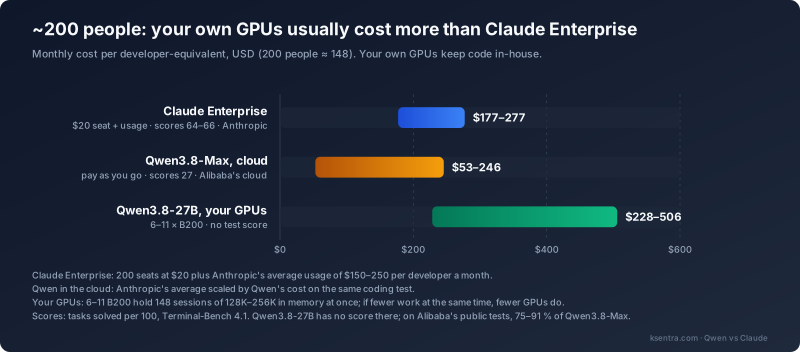
- about 200 people (147.5 developer-equivalents): $228–506 each, from $33,682–74,599 for 6–11 B200 GPUs, against $177–277 on Claude Enterprise ($20 a seat plus usage at Anthropic's average, our assumption).
The GPU figures are rent for Qwen3.8-27B at hourly list prices, sized so every user's 128–256 thousand-token task stays in GPU memory at once. They say nothing about speed, and staff and setup come on top. Pro, Ultra and Team seats carry usage limits; Enterprise bills usage on top of the seat.
So keeping your code and data inside the company is something you pay for; if they may go to a cloud, Claude usually costs less than your own GPUs and scores highest of the models compared here.
How far behind is Qwen at writing code?
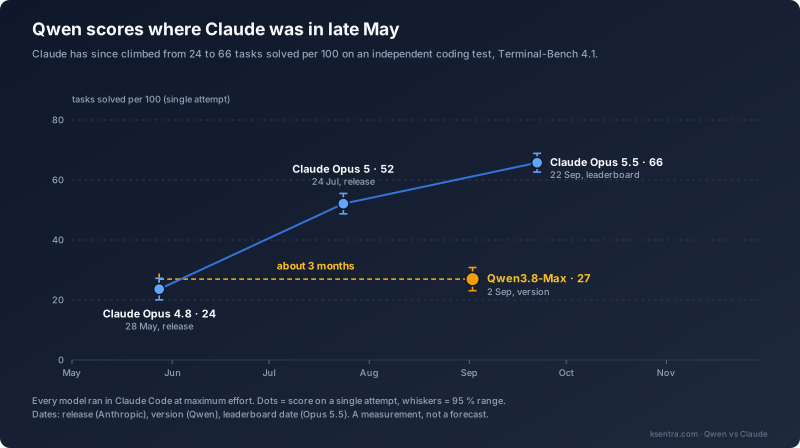
On coding, Claude is clearly ahead. Qwen's one tested model, Qwen3.8-Max (version of 2 September), scores about what Claude's model of 28 May scored (23.64). On Terminal-Bench 4.1, an independent test, Claude's best models solve about 66 tasks in 100 and Qwen3.8-Max about 27.
Terminal-Bench 4.1 gives an AI agent real tasks in a terminal, the text window developers type commands into, and checks whether each task is done. Each model gets 330 attempts, so "27 in 100" is the share of single attempts that pass. Every result below ran in Claude Code, Anthropic's coding tool, at the leaderboard's "max" effort setting, which controls how long the model thinks; whether it means the same across vendors isn't stated.
| Model, in Claude Code at "max" effort | Tasks solved per 100 (the range the test states) | Date |
|---|---|---|
| Claude Opus 5.5 | 65.76 (62.7–68.9) | September 2026 (on the leaderboard from 22 September) |
| Qwen3.8-Max, through Alibaba's cloud | 26.97 (23.1–30.8) | version of 2 September 2026 |
| Claude Opus 4.8 | 23.64 (20.1–27.2) | published 28 May 2026 |
Claude Fable 5, on the leaderboard from 9 June 2026: 44.85 (41.0–48.7).
Qwen3.8-Max's range overlaps Opus 4.8's, so the test can't tell them apart. Fable 5, the next Claude model on the leaderboard by date, scores clearly higher. In the 117 days from 28 May to 22 September, Claude's best result went from 23.64 to 65.76; on the day of Qwen3.8-Max's version, Claude's best result at "max" effort was Fable 5.1's 57.27.
What this test doesn't show
- Qwen has one result on it. It is Qwen3.8-Max, as Alibaba serves it from its cloud. Qwen4-Max (16 November) and the Qwen models you can run on one server have none.
- The tool. Alibaba itself tests Qwen3.8-Max in Claude Code, and its model page says "Qwen3.8-Max performs best on Claude Code". Kimi K3.1 Pro scores far higher in the same tool (item 3), so the tool doesn't explain the gap. One limit: there is no Qwen result in Qwen's own tool, Qwen Code.
- Other models score closer to Claude in the same tool. Kimi K3.1 Pro reaches 59.70, with a $1,087 test bill, the leaderboard's own figure. It is the highest open-weight result on the board: Moonshot AI publishes its weights (about 2.8 trillion parameters, about 1.6 TB: more than one 8-GPU H200 or B200 server holds) under its own licence, which requires a separate agreement only from a group that sells access to AI models and has more than $20 million in revenue a year; internal use needs none. GLM-5.3 scores 41.21, close to Claude Haiku 5.5's 40.00. Open models compared with Claude.
Qwen Code, Qwen's own coding tool, is compared in our guide to coding tools; OpenAI's is in the Codex comparison.
What vibe coding costs at three team sizes
Per test run, Qwen3.8-Max costs less than Sonnet and from about a third of Opus's cost up to about the same. Against the Claude plan each size would buy, it costs more for one person and for a team of 10. At about 200 people it costs less or about the same (the charts below). It scores far lower at every size. Qwen3.8-27B on your own GPUs, with every user's long coding task kept in GPU memory, costs more per developer-equivalent than Claude's plan for one person and a team of 10. At about 200 people it usually costs more: $228–506 against $177–277, before staff and setup. It has no score on the test.
| Route | Score on the test (per 100) | Who runs the model | One person | Team of 10 (about 8 developer-equivalents) | About 200 people (about 148 developer-equivalents) |
|---|---|---|---|---|---|
| Claude Opus 5.5, pay as you go | 65.76 | Anthropic | $150–250 | $1,238–2,062 | $22,125–36,875 |
| Claude Sonnet 5.5, pay as you go | 63.94 | Anthropic | $175–389 | $1,444–3,205 | $25,816–57,310 |
| Qwen3.8-Max through Alibaba's cloud, pay as you go | 26.97 | Alibaba | $53–246 | $437–2,026 | $7,821–36,227 |
| Claude seats (usage limits apply) | by the model used | Anthropic | $20–200 (Pro to Ultra) | $250–1,250 (Team: standard to premium seats) | $26,125–40,875 (Enterprise at $20 a seat, plus usage at Anthropic's average, our assumption) |
| Qwen3.8-27B on your own GPUs, rent to the GPU cloud, every task held in memory | no score | you | $2,081–2,873 (one H100) | $4,162–5,746 (two H100) | $33,682–74,599 (6–11 B200) |
All cells: monthly totals, our arithmetic on list prices; sizes are examples. Per developer-equivalent = the cell divided by 1, 8.25 or 147.5; for your company, multiply that figure by developers + 0.5 × testers + 0.25 × everyone else. Own-GPU rows: every user's 128–256 thousand-token task held in GPU memory at once. Inputs in "How we counted" below.
Anthropic says that across enterprise deployments Claude Code averages $150–250 per developer a month; it doesn't state the model mix (plans in Claude Code plans for business). We take that average as Opus 5.5's level and scale the other rows by what a full run of the same test cost each model: Opus 5.5 $4,299–4,719, Sonnet 5.5 $5,016–7,334, Qwen3.8-Max $1,519–4,636.
A working team mixes Claude's models, for example Opus for planning and specs and Sonnet for most of the coding, so its bill falls between those two rows. Models spend different amounts of tokens on the same tasks. Sonnet used 2.4 times as many as Opus, most of them earlier text re-read from the cache (stored text billed at a lower rate). So a price per token says little; your pilot measures the real bill.
How we counted the coding costs
- Sizes (examples; change them to yours): team of 10 = 7 developers, 2 testers, 1 analyst or project manager; about 200 people = 120 developers, 30 testers, 50 analysts, project managers and IT staff. Weights (our estimate): developer 1, tester 0.5, the rest 0.25; the same weights set the sessions on your own GPUs (1, 9 and 148).
- Test-run cost, two ways: each model's tokens on the test at Anthropic's or Alibaba's list price before tax, without the charge for writing text to the cache, which the test doesn't report. The cache is text the provider has already processed and keeps, billed at a lower rate when reused. The second way is the test's own bill. Each range runs from the lower of the two to the higher.
- Seats: Claude's pricing page, before tax, monthly billing. Claude Team plan: from $25 a standard seat to $125 a premium seat, Claude Code in both. Claude Enterprise pricing: $20 a seat billed annually, plus usage, which we take at Anthropic's average (our assumption).
- GPUs for Qwen3.8-27B: sized so every user's open task of 128–256 thousand tokens stays in GPU memory at once, one session per developer-equivalent.
- Memory per session: stored at 8-bit precision, one byte per number instead of the usual two. Only 16 of the model's 64 layers keep it (its configuration file): 16 layers × 2 × 4 heads × 256 values × 1 byte = 32 KB per token. That is about 4 GB per session at 128 thousand tokens and 8 GB at 256 thousand.
- The model and the software: the model itself takes about 28 GB at 8-bit. We assume 90 % of a GPU's memory is usable and 6 GB of it goes to the serving software (our assumptions).
- Sessions per GPU, at tasks of 128 or 256 thousand tokens: one 80 GB GPU holds 8 or 4 sessions, two sharing one copy of the model hold 23 or 11, and one B200 holds 28 or 14. A 24 GB card holds a compressed copy and one session of up to about 128 thousand tokens.
- Speed: these counts say nothing about it. When several people send long tasks at once, each waits while the GPU reads the others'.
- Rent: H100 from RunPod Secure Cloud's list (23 October 2026): $2.89 per GPU-hour for H100 PCIe to $3.99 for H100 SXM, 720 hours a month as on our private platform page. SXM is the version that links two GPUs fast enough to share one model copy. The 24 GB rent ($640–860 a month) and the 80 GB range for chatbots and agents ($1,290–2,080, an A100 to an H100 PCIe) are from the same page. B200: Lambda $7.69 and Together AI $9.29 per GPU-hour, 730 hours. A host in your own jurisdiction charges its own rate.
Not measured:
- how many people work at the same time (fewer at once need fewer GPUs);
- speed with several long tasks at once;
- the quality cost of 8-bit memory;
- bought, reserved or other hardware;
- cache charges in real use;
- how the models you can run yourself score on your own setup;
- Qwen's subscription prices;
- tokens per agent task;
- your staff time;
- whether "max" effort means the same across vendors.
Qwen3.8-27B on your own GPUs against Claude's plans, by team size
All three lines are GPU rent only, with every user's 128–256 thousand-token task held in GPU memory at once.
- One person: one H100 GPU ($2,081–2,873 a month) costs more than every cloud route in the coding cost table. A 24 GB card ($640–860) holds a compressed copy and one task of up to about 128 thousand tokens; it still costs more than a Claude subscription.
- Team of 10: two H100 GPUs ($4,162–5,746) cost more than Claude Team for the team ($250–1,250) and more than Qwen3.8-Max in Alibaba's cloud ($437–2,026).
- About 200 people: 6–11 B200 GPUs ($33,682–74,599) usually cost more than Claude Enterprise for the same people ($26,125–40,875, seat plus usage at Anthropic's average).
- If fewer people work at once: a real load can need fewer GPUs than our sizing. Revolut (its talk is quoted below) serves about 36 engineers per B200 GPU, but on GLM-5.3, a much larger model with a different memory design. The trade: a task pushed out of GPU memory is processed again in full at the user's next step, and answers slow down. A load test sets the number.
Pros and cons: Claude, Qwen3.8-Max and Qwen3.8-27B for coding
| Route | Good for | Watch for |
|---|---|---|
| Claude Opus and Sonnet | the highest scores of the models compared here; Opus for planning and specs, Sonnet for most of the coding | the bill grows with use; on this test Sonnet costs more than Opus |
| Claude seats | a predictable bill up to a usage limit | usage limits apply; Claude Code plans for business |
| Qwen3.8-Max through Alibaba's cloud | per test run, less than Claude Sonnet, and from about a third of Opus's cost up to about the same | the lowest score on Terminal-Bench 4.1 here, about 27 tasks in 100 against 64–66; code goes to Alibaba's cloud; the Qwen Code subscription price wasn't published where we could read it |
| Qwen3.8-27B on your own GPUs | code stays in; no per-token bill | GPU rent above Claude's plan for one person and a team of 10, usually above at about 200 people, with every task held in memory; no score on the test; speed untested; staff, setup and tuning on top |
Other hosted models score higher than Qwen3.8-Max for far less: DeepSeek V4.1 Flash 38.48 with a $185 test bill and GLM-5.3-Flash 36.97 with $375, against Qwen3.8-Max's $4,636 (the leaderboard's own bills).
For a software team whose code may not leave the company or the country, our vibe coding service offers a closed setup: your own server, or a setup hosted in your jurisdiction. We set it up and support it.
One company's numbers: Revolut
In an October 2026 talk, Revolut said it serves the open model GLM-5.3 to roughly 2,000 engineers on 56 B200 GPUs, keeping Claude Code and Codex "as exception". It put its invoice at "one-tenth of what we were spending on Anthropic and OpenAI". At list rents, 56 GPUs cost about $157–190 per engineer a month.
That is below our sizing, which holds every user's task in memory at once; the talk doesn't say how many engineers work at the same time. It also gives neither the earlier spend nor whether the GPUs are owned, so the "one-tenth" can't be checked. The talk page's own caveat: "Those figures describe Revolut's deployment and utilization, not a portable price for any self-hosted model."
Chatbots and AI agents: the cost on Claude, Qwen or your own servers
A chatbot's tokens are a small line on a small model at every size. An agent's tokens on a larger model can cost as much as a rented GPU, and more if its tasks run longer.
Chatbots
Our chatbots are hybrids: a scripted tree handles the routine steps, and a model answers the open-ended questions. Across 83 chats on our own bots (July–October 2026), the typical chat used about 2,200 tokens and the average one about 4,000, so the monthly totals below use the average. The loads are examples of a company's customer and staff chats on its own bot; the "per 1,000 chats" column lets you put in yours.
| Model, tokens only (our arithmetic on list prices) | Per 1,000 chats | One person: 1,000 chats a month | Team of 10: 10,000 | About 200 people: 100,000 |
|---|---|---|---|---|
| Claude Haiku 5.5 | $0.49 | $0.49 | $4.90 | $49 |
| Claude Sonnet 5.5 | $9.81 | $9.81 | $98 | $981 |
| Qwen3.8-Flash, through Alibaba's cloud | $0.67 | $0.67 | $6.71 | $67 |
| Qwen4-Max, through Alibaba's cloud | $6.66 | $6.66 | $67 | $666 |
| Your own servers, rent to the GPU cloud | — | $640–860 (one 24 GB GPU) | $640–2,080 (one 24 GB GPU to one 80 GB A100 or H100 PCIe) | $1,290–2,080 per 80 GB GPU, A100 or H100 PCIe (how many: a test at your real load) |
Agents
An agent works through a task in steps and reads far more text than a chat. For an agent that answers from your documents we assume 50,000 tokens per task; a coding agent reads far more. Part of each task's text is cached, that is, already read and billed at a lower rate. The price per task is shown so you can rescale.
| Model, tokens only (our arithmetic on list prices) | Per task, nothing cached | Team of 10: 1,050 tasks a month | About 200 people: 21,000 tasks |
|---|---|---|---|
| Claude Haiku 5.5 | $0.0062 | $2.96–6.51 | $59–130 |
| Claude Sonnet 5.5 | $0.124 | $55–130 | $1,104–2,604 |
| Qwen3.8-Flash, through Alibaba's cloud | $0.0085 | $3.59–8.88 | $72–178 |
| Qwen4-Max, through Alibaba's cloud | $0.084 | $32–88 | $639–1,764 |
| Your own servers, rent to the GPU cloud | — | $640–860 (one 24 GB GPU) | $1,290–2,080 per 80 GB GPU, A100 or H100 PCIe |
No agent tasks are assumed for one person.
What the chatbot and agent tables show
- Chatbots: even at 100,000 chats a month of about 4,000 tokens each, a small model's tokens cost $49–67 and a larger model's $666–981 (tokens only). Your own servers start at one 24 GB GPU's $640–860 a month, whatever the load. So running a chatbot's model yourself is a decision about where the data may go.
- Agents, 200-person example (21,000 tasks a month, 50,000 tokens a task, 0–80 % cached, our assumptions): one rented 80 GB GPU (A100 or H100 PCIe) costs $1,290–2,080. Sonnet 5.5's agent tokens cost about the same ($1,104–2,604), and Qwen4-Max's up to about that ($639–1,764). Haiku 5.5's and Qwen3.8-Flash's cost far less ($59–130 and $72–178). Which comparison is fair depends on answer quality on your documents.
| Route | Good for | Watch for |
|---|---|---|
| A cloud model (Claude, or Qwen through Alibaba's cloud) | no hardware; small token bills on small models | your documents go to the model's vendor; larger models add up for agents |
| An open model through another provider's API (pay-per-use access over the internet) | low prices per token | not private: documents go to that provider's cloud, under its contract |
| An open model on your own servers | documents stay on servers you control; no per-token bill | rent from $640 a month at any load; staff and setup; the open models that fit one server can answer less well |
No independent test we read measures answers from a company's own documents. Our cloud platform service and private platform service run that test on your own questions before the model is chosen, then pilot the chosen setup. Our bots and agents answer people who write in; we don't build outbound calling or voice agents.
How we counted: token costs only, with reasoning off; setup, knowledge-base hosting and our fees excluded. Agent tasks: 50,000 tokens each, 0–80 % of the text cached at each vendor's cache price, cache-write charges not counted, about 105 tasks per person a month in the team examples (our assumptions).
Want your bots and agents on a layer that fits your data?
Tell us what you run or plan to run, and we will show which option fits your data.
What running a model yourself buys, and what it costs beyond the GPUs
A local LLM, a language model on servers you control, buys three things:
- code and documents go to no outside AI service;
- your security team can assess the setup against its own rules;
- there is no per-token bill.
It costs more than the GPUs:
- Hardware or rent. One 80 GB GPU holds Qwen3.8-27B and the memory for about 8 users' long coding tasks at once (128 thousand tokens each), or 4 at 256 thousand. How fast it answers with 8 working only a load test shows. A 24 GB card holds a compressed copy and one task of up to about 128 thousand tokens. Which model fits which server, and what each costs a month, is on our private platform page. One server has no backup; a second one for uptime doubles the rent.
- Staff and tuning. Someone runs the servers, updates the models and watches speed: Revolut's tuning cut the wait for an answer's first word from 14 seconds to under 2.
- Quality. The open models that fit on one or two servers can answer less well than the strongest cloud models. Qwen's one-server models have no result on the coding test. Alibaba ran three public coding tests itself and published them on the model pages of Qwen3.8-27B and Qwen3.8-Max's weights. On them Qwen3.8-27B scores 75–91 % of Qwen3.8-Max: SWE-bench Pro 91 %, NL2Repo 76 %, DeepSWE 75 %. Qwen3.8-Max solves about 27 tasks in 100 on the independent test, against 64–66 for Claude's best models. Alibaba's own tests are not independent ones.
- Our work, if you hire us for it. On our private platform page, the sizing spec is $1,500 and counts toward the setup of a private platform on servers you control, which is from $10,000; remote support is from $1,000 a month.
Which open models run where
| Server | Models | Licence | Note |
|---|---|---|---|
| One GPU | Qwen3.8-27B (on our private page's table) · Qwen3.6-27B (the older one) | Apache-2.0 | no coding-test result; 75–91 % of Qwen3.8-Max on Alibaba's own public tests; a pilot on your questions decides between them |
| A larger server | Qwen3.8-Flash-Next (Alibaba calls it a preview of the design behind Qwen4) | Qwen's own licence | no coding-test result |
| A cluster of servers | Qwen3.8-2.4T-A95B, the open weights Qwen3.8-Max is built on | Qwen's own licence | the hosted Qwen3.8-Max solves 26.97 tasks in 100 on the coding test |
| Eight large GPUs | GLM-5.3 (Z.ai) | its own licence | 41.21 on the coding test as Z.ai serves it, higher than any Qwen result |
"One GPU" usually means a compressed model, one stored with fewer bits per number so it takes less memory; compression can cost some quality. A 27-billion-parameter model fits a 24–32 GB card compressed, with room for one task of up to about 128 thousand tokens. On an 80 GB card at 8-bit precision it has memory for about 8 users' tasks of 128 thousand tokens. For coding, an open model on your own servers doesn't have to be Qwen.
Licences, in plain words
- Qwen3.8-27B and Qwen3.6-27B are Apache-2.0: a company may use them commercially; if it passes a model on, it must include the licence.
- Qwen3.8-Flash-Next and the Max weights have Qwen's own licences (Flash-Next, Max weights). They need a separate licence from Qwen only if your company, or any company in your group, sells access to AI models, or sells its own AI assistant product for coding or office work. For the Max weights, the group's revenue must also be over $50 million a year.
- Even then, using these models inside your company, without giving the model or its answers to anyone outside, needs no separate licence.
- GLM-5.3's licence adds a security review by Z.ai, only for a group that sells access to AI models and has more than $10 billion in total revenue a year. GLM-5.3-Flash is MIT.
- Through a provider's API, the provider runs the model and you work under its contract.
Our private platform service works with Apache-2.0 and MIT models; with Flash-Next, the Max weights or GLM-5.3, you hold the licence. For a software team, our vibe coding service offers the same route as a closed setup.
How to choose between Qwen and Claude: a test on your own tasks
- Writing code. If the code may go to a cloud, Claude scores far higher than Qwen3.8-Max; find your size's column in the coding cost table. Our vibe coding service decides with you where each kind of code may go and runs the pilot.
- Code or data may not leave the company. An open model on your own servers: what it buys and costs.
- A tight budget, and code that may go to a cloud. Put Qwen3.8-Max next to Sonnet on your own tasks: it costs less per run, and your test shows how much more of the work it leaves undone. Our cloud platform service can run that test with you.
- Everyday chat, writing and analysis. No independent test we read covers it, so test it the same way.
The test: run the same 20–30 real tasks (bug fixes, small features, customer questions) through two or three candidates and count what passes without rework. A table to copy:
| Task | Passed without rework? | Minutes to fix |
|---|---|---|
Our cloud AI platform service and private AI platform service run this test on your own questions before the model is chosen, then pilot the chosen setup; in the private one, on non-sensitive or made-up documents first.
Qwen vs Claude FAQ
Is Qwen better than Claude?
For coding, no: on Terminal-Bench 4.1, in Claude Code at "max" effort, Claude's best models solve about 66 tasks in 100 and Qwen3.8-Max about 27. For a chatbot, choose by where your data may go.
Is Qwen cheaper than Claude?
No, except at about 200 people, against the Claude plan a buyer would take. Per developer-equivalent a month, Qwen3.8-Max through Alibaba's cloud costs $53–246, against $20–200 for Claude Pro to Ultra, $30–152 on Claude Team and $177–277 on Claude Enterprise. The Qwen figure is our estimate from Anthropic's stated average and each model's cost on the coding test. Per run of the coding test, it costs less than Claude Sonnet 5.5 and up to about the same as Opus 5.5. It solves far fewer tasks: about 27 in 100 against 64–66.
Does running a model ourselves save money?
No for one person or a team of 10; at about 200 people, usually not (at hourly list GPU rents). Qwen3.8-27B on your own GPUs, with every user's 128–256 thousand-token task kept in GPU memory, costs $2,081–2,873 a month for one person, $4,162–5,746 for a team of 10 and $33,682–74,599 for about 200 people. Claude's plans for the same sizes cost $20–200, $250–1,250 and $26,125–40,875. Staff and setup come on top. If fewer people work at once, fewer GPUs may do; a load test decides.
What does it take to run Qwen on our own servers?
Qwen3.8-27B (Apache-2.0) on one H100 GPU, $2,081–2,873 a month at one US GPU cloud's list price, has memory for about 8 users' 128 thousand-token tasks at once. How fast it answers with 8 working only a load test shows. A 24 GB GPU, from about $640, runs a compressed version for one person or for short tasks such as a chatbot. Add staff, setup and tuning.
Which is better for a customer chatbot?
Choose by where the data may go. On a small model the tokens are cheap: $49–67 a month for 100,000 chats on Claude Haiku 5.5 or Qwen3.8-Flash (our arithmetic on list prices, chats of about 4,000 tokens, no setup, hosting or platform fees).
Is Qwen free?
Qwen's open-weight models are free to download; you pay for the hardware that runs them (from about $640 a month for one rented 24 GB GPU) or for a provider that hosts them. Qwen Code, Qwen's coding tool, no longer has a free sign-in (November). Claude's paid plans start at $20 a month (Pro); we didn't compare the free tiers of the two chat apps.
Is it safe to give Qwen our code or data?
It depends on where the model runs: on your own servers, code and data stay with you; through Alibaba's cloud they go to Alibaba, and your own data rules decide whether that's allowed.
Can we use Qwen commercially?
Yes, with conditions by model. Qwen3.8-27B and Qwen3.6-27B are Apache-2.0: if you pass the model on, include the licence. Qwen3.8-Flash-Next and the Max weights need a separate licence from Qwen only if your group sells access to AI models or its own AI assistant product for coding or office work (for the Max weights, with group revenue above $50 million a year).
Not sure which route fits your jobs and size?
Start with a free 30-minute call: tell us what the model must do and where your code and data may go, and we will show which routes to test on your own tasks.
What changed since this page was first published
| Date | Change | What it means for you |
|---|---|---|
| November | Qwen Code's sign-in page now asks for a paid Qwen subscription, an API key or a model you host; the free sign-in tier has ended | don't plan a free Qwen Code rollout |
| 17 Nov | A new top result on Terminal-Bench 4.1: GitHub Copilot with Copilot Fusion, 71.21 | the gap here is measured against Claude's best models, not the top of the leaderboard |
| 16 Nov | Qwen4-Max: in Alibaba's cloud only, no weights, no Terminal-Bench result. Alibaba reports 6th place on Code Arena (a third-party leaderboard, quoted from Alibaba's release) and says smaller open Qwen4 models "will soon be released" | nothing new to run on your own servers yet |
| 9 Nov | Claude Code with Fable 5.2 ties Opus 5.5 at 65.76, with a test bill about 3.5 times Opus 5.5's | Claude's best score on the test is unchanged |
We re-read this page when open Qwen4 weights appear or the test adds a Qwen4 result.