Strategic AI for Business
Your business has a strategy. Your AI tools have outputs. The gap between the two is where strategy gets lost — in handoffs, in shifting priorities, in the daily pull of urgency over importance. Strategic AI closes that gap. We design and operate AI systems that understand your business objectives, track progress against key results, and flag when work drifts from the plan.
What Is Strategic AI for Business?
Most AI tools answer questions. AI agents execute workflows. An AI team orchestrates multiple agents to hit key results. Strategic AI operates one level deeper: it doesn't just fulfill your OKRs — it proposes, evaluates, and challenges them.
This is the difference between Gen 4 and Gen 5. A Gen 4 AI team receives objectives and figures out how to meet them. A Gen 5 strategic AI system operates on the "why" layer: why does this business area exist? Is this the right objective? Should you pivot? It accumulates context over months of working sessions, spots patterns the daily grind obscures, and raises questions you haven't thought to ask yet.
The human retains final authority on all objectives. The AI's role is persistent strategic advisory: proposing priorities based on KR progress, flagging when daily work drifts from strategy, and challenging assumptions when evidence warrants it. When the plan and reality diverge, the system surfaces the gap before it compounds.
If your business doesn't yet run on quarterly OKRs, start with AI consulting first. Strategic AI is the layer above — it delivers the most value when there are real objectives to track and real decisions to inform.
→ How all five generations of AI business systems compare
How Strategic AI Works
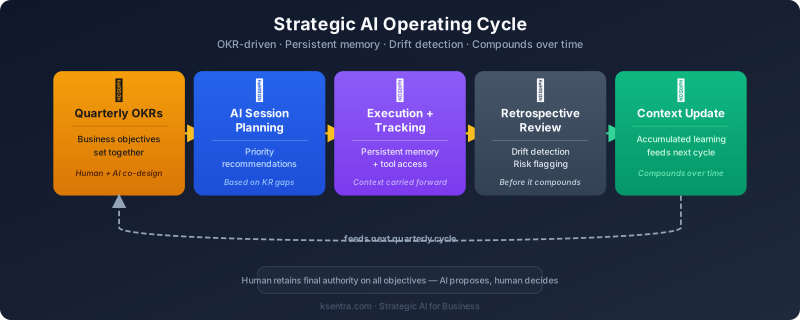
Strategic AI for business operates on a quarterly cycle tied directly to your objectives. At the start of each quarter, we establish OKRs together. Each working session opens with AI-proposed priorities based on current key result progress, not on what feels urgent that day. The AI tracks execution, flags when work drifts from the plan, and surfaces risks before they become blockers.
After each session, context is updated and carries forward. Over months, the system builds institutional knowledge — the kind your business would otherwise lose between projects, between hires, and between strategy reviews.
This is what OKR-driven AI looks like in practice: not a chat tool with a good memory, but an AI system that holds the plan and holds you to it.
How We Work
Strategy Architecture
— 2 weeksWe define your OKR framework, map current decision workflows, and design the strategic AI architecture: memory system, session protocols, retrospective cadence, and KR tracking.
System Setup
— 2 weeksWe build the context infrastructure: memory files, OKR dashboards, session orchestrators, and integration with your working tools. We establish the operating charter and run the first live session together.
Operating Quarter
— 3 monthsThe system runs under our guidance: weekly check-ins, monthly strategic reviews, retrospective analysis, and continuous context updates. We ensure KR tracking stays accurate and drift gets caught early.
Handoff or Continuation
— OngoingAfter one operating quarter, you can run the system independently, expand it to new objectives, or continue with Ksentra as an embedded strategic advisor.
A Working Prototype — Running on Ksentra Itself
We didn't design this product on paper. The Ksentra business itself runs on a fifth-generation strategic AI system: a human founder and an AI system operating under a shared OKR framework, operating charter, and accumulated context built over months of working sessions.
The entire AI transformation strategy, product catalog, service architecture, and content execution that built this website were co-developed through this system.
We're transparent about what it is: the AI's "memory" is structured documents loaded each session, not continuous cognition. The human has full override power. The AI's ability to challenge assumptions is trained behavior, useful regardless of mechanism. The design pattern works and delivers strategic value now. We've built it, we operate it, and we're prepared to build it for you.
Frequently Asked Questions
Is strategic AI right for my business, or is this too advanced?
If you're already running AI agents or have clear quarterly OKRs and want AI that holds you accountable to them, this is the right level. If you're earlier in your AI journey, AI consulting will help you find the right starting point. Businesses starting from scratch often begin with AI assistants or AI chatbots and grow into the strategic layer over time. Strategic AI delivers the most value when there's real strategic complexity to manage: multiple objectives, competing priorities, or fast-moving execution where drift happens quietly.
What do you need from us to get started?
A willingness to define quarterly OKRs and review progress honestly. A decision-maker (owner or senior executive) who engages with the system directly, not through a delegate. Basic tool access (shared documents, task tracking, or whatever your team uses). Strategic AI requires genuine strategic engagement, not just task delegation. Your OKR data and all system documentation remain yours — no vendor lock-in.
How long before we see results?
The first strategic session typically produces a prioritized action list that changes what you work on the following week. Deeper value — accumulated context, drift detection, and multi-month KR tracking — compounds over a full operating quarter. Most clients report the most significant shift around the 6–8 week mark, when retrospective patterns start emerging.
What does strategic AI cost?
Pricing depends on business scale and OKR complexity. We use a base consulting fee plus an objective-based success component, so Ksentra's incentives align with your key result outcomes. We'll discuss a clear pricing structure on the first call. No commitment required to have that conversation.
Have you delivered this for external clients?
This is the most advanced product in our catalog. Ksentra's own growth is the first full deployment and a working proof of concept. We're selectively onboarding clients for the first external engagements in 2026, with Ksentra providing close oversight. If you're interested in being among the first, the right step is a direct conversation. We'll be honest about readiness on both sides.
What's the difference between strategic AI and AI consulting?
AI consulting gives you a roadmap: an honest assessment of where AI fits, what to build, and in what order. Strategic AI operates the roadmap — it runs with you through execution, tracks KR progress, flags drift, and adapts priorities as the quarter unfolds. Consulting is a project. Strategic AI is an ongoing operating relationship.